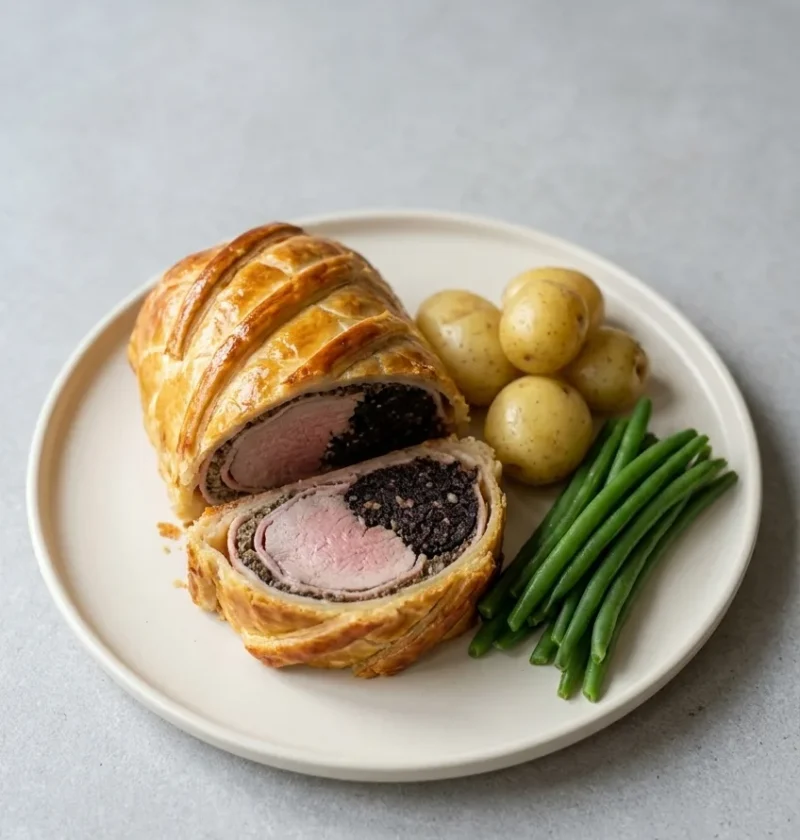
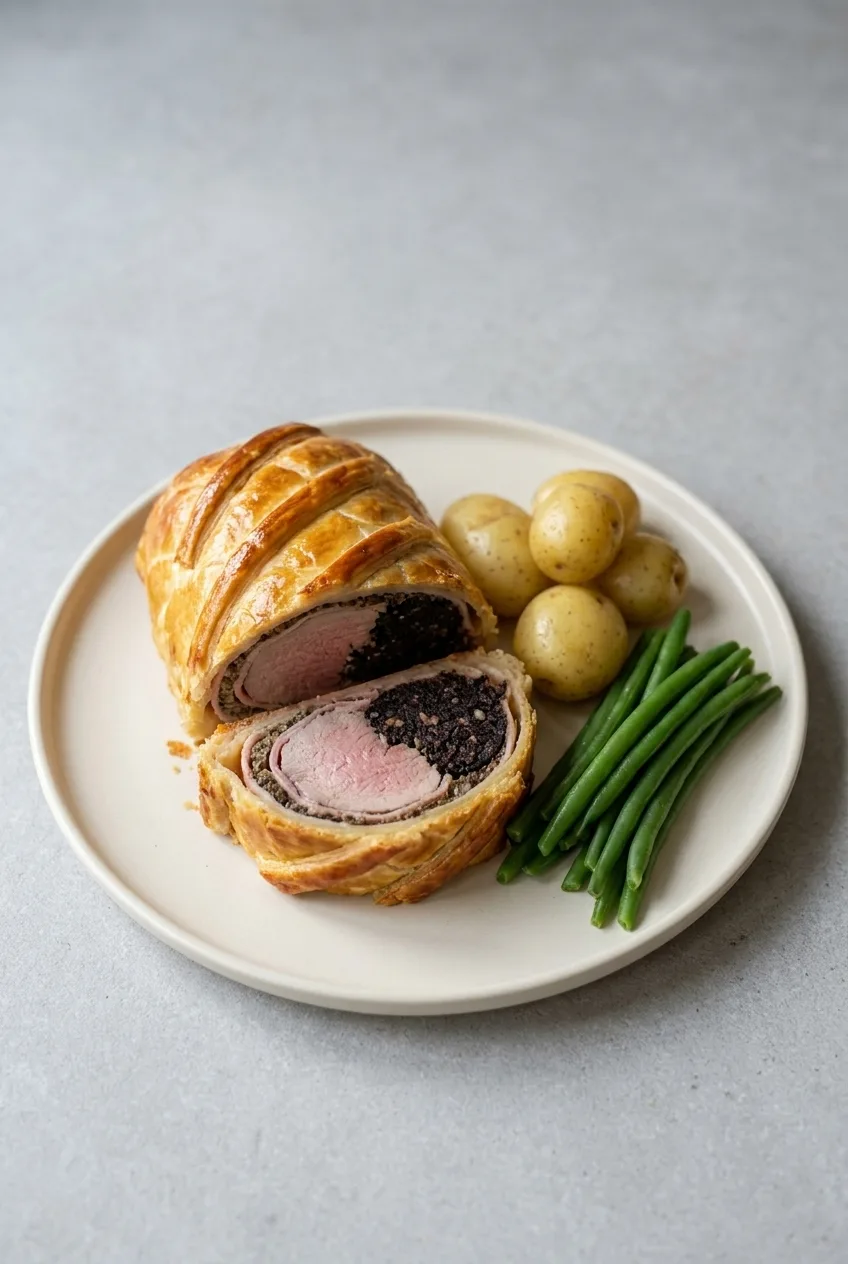
Hairy Bikers pork wellington swaps beef fillet for a pork tenderloin, which is a lot cheaper. The recipe is in Meat Feasts, so it serves four at roughly 945 calories and takes 1 hour 35 minutes.
Si and Dave write in Meat Feasts that “Pork is more forgiving”, and that is the real argument here. A beef wellington has to come out pink in the middle, while pork just needs to be cooked through.
What is less forgiving is the pastry, so six slices of prosciutto go under the filling to keep it dry. Pat the seared pork dry with kitchen paper too, because any moisture left on it turns the base to paste.
Hairy Bikers Pork Wellington Recipe
Description
Onion is softened and flamed with Calvados, then mixed with diced apple, sage and crumbled black pudding. The seared tenderloin sits on that filling and gets rolled up in ham and puff pastry, then baked hot before the heat drops. Ten minutes resting before it is sliced.
Ingredients
For the Filling:
For the Wellington:
Instructions
- Soften and flame the onion: Heat the butter in a non-stick frying pan and fry the onion for several minutes until soft and translucent. Turn the heat right up, add the Calvados and let it bubble until it has almost completely evaporated, then take the pan off the heat and leave the onion to cool completely, which takes about 15 minutes and cannot be rushed, since warm onion melts the black pudding.
- Mix the filling: Put the cooled onion in a bowl with the apple, sage and black pudding, then season with salt and pepper and mix it all together well.
- Sear the pork: Heat the olive oil in the frying pan and fry the tenderloin, turning it regularly, until sealed and well browned all over. Take it off the heat, then heat the oven to 200°C/Fan 180°C/Gas 6.
- Roll the pastry: Dust a work surface with flour and roll the pastry into a rectangle slightly longer than the pork and wide enough to wrap it completely, at least 30 x 40cm.
- Layer it up: Lay the prosciutto over the pastry, leaving a border of at least 1cm all round. Spread the black pudding mixture over the ham, pat the seared pork dry with kitchen paper, then lay it along the centre.
- Wrap and seal: Brush the pastry edges with beaten egg and wrap it round the pork into a large sausage shape. Press the ends together so the parcel is completely sealed, tuck them underneath, then sit it on a non-stick baking tray seam side down.
- Glaze it: Decorate the top with pastry offcuts if you like, then brush the whole thing with more beaten egg.
- Bake and rest: Bake for 20 minutes, then turn the oven down to 180°C/Fan 160°C/Gas 4 and cook for another 15 to 20 minutes, until the pastry is golden brown. Leave it to rest for at least 10 minutes before slicing.
FAQs
Why prosciutto here when a beef wellington uses pancakes?
Both are doing the same job, keeping wet filling away from raw pastry, and it is worth seeing them side by side. The beef wellington in Perfect Pies makes three thin herb pancakes and wraps the fillet in those before the pastry goes on.
Prosciutto is the quicker answer and it suits pork better, since cured ham and pork are the same animal and the salt seasons the tenderloin from the outside. It is also the more forgiving barrier here, because Si and Dave describe this filling as quite moist and juicy, and a sheet of ham handles that without you having to make a batter first.
Can I leave out the Calvados?
You can, though you lose more than you might expect. It is apple brandy, so it doubles up with the diced apple in the filling and ties the whole thing to the pork.
Dry cider is the closest swap and it keeps the apple flavour running through the dish. You will need noticeably more of it than the 50ml of Calvados, since cider is far weaker, and it wants boiling down the same way until the pan is almost dry. Do not skip that reduction whatever you use, because liquid left in the onion mixture goes straight into the pastry.
Do I have to use black pudding?
It is the whole character of the recipe, so leaving it out gives you a fairly plain pork parcel. If black pudding is not for you, this is probably not the recipe to adapt.
A better option is to cook a different stuffed tenderloin instead. The stuffed pork fillet uses the same cut but fills it with apple, apricot and stem ginger and wraps it in streaky bacon rather than pastry, so you get the same idea without the pudding or the pastry work.
How do I know the pork is cooked when I cannot see it?
You mostly go by the pastry, which is the honest answer. Golden brown after the full 35 to 40 minutes means the pork inside is done, because a tenderloin is thin and it was already seared before it went in.
If you want certainty, push a probe through the end of the parcel into the centre of the meat. The rest is what really matters though, since ten minutes lets the juices settle instead of running out over the board the moment you cut it.
How do I stop the bottom going soggy?
Seam side down on the tray is the instruction people skip, and it matters. The join is the thickest part of the pastry, so putting it underneath means the weight of the meat presses it into the hot tray and it cooks through rather than steaming.
The cornish pasty handles the same problem from the other direction, cutting a vent in the top so steam escapes upwards. This recipe seals completely instead and relies on the ham and the short cooking time. If you want gravy with it, Si and Dave suggest apple sauce or cider gravy, and the pork and apple pie has a cider gravy method you can borrow.