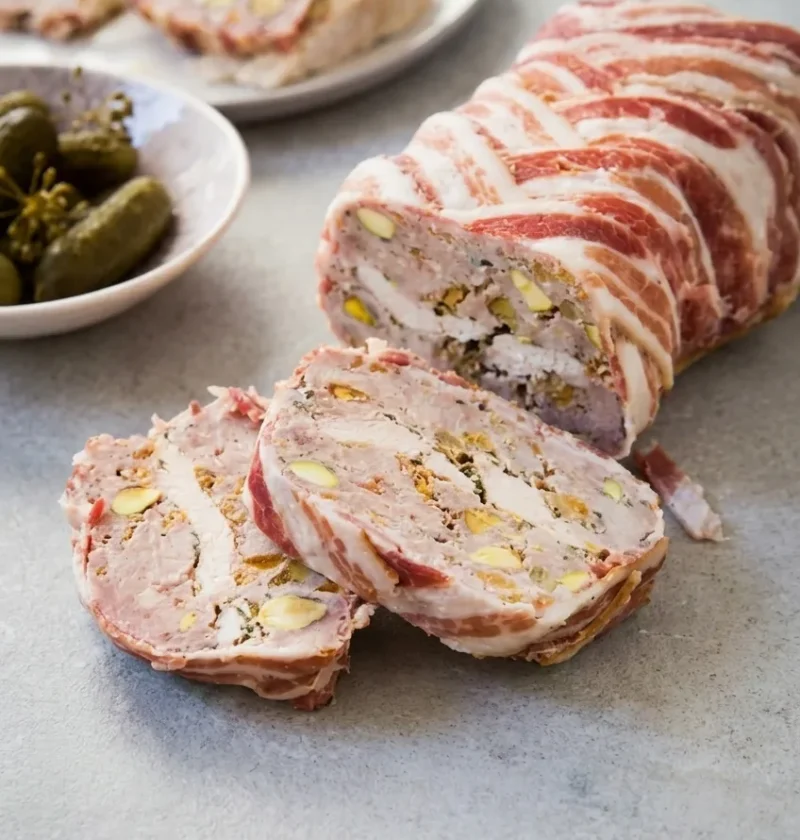
Hairy Bikers pork terrine is in two cookbooks, and they do not agree on how many it feeds. British Classics says this pork and chicken terrine serves six to eight while Chicken and Egg says four, so the version here follows British Classics at 745 calories.
Si and Dave write in British Classics that a terrine “looks really fancy and impressive but actually isn’t that difficult to make”. They are right, because there is no pastry and no fiddly shaping, though you do need 15 hours since it chills overnight.
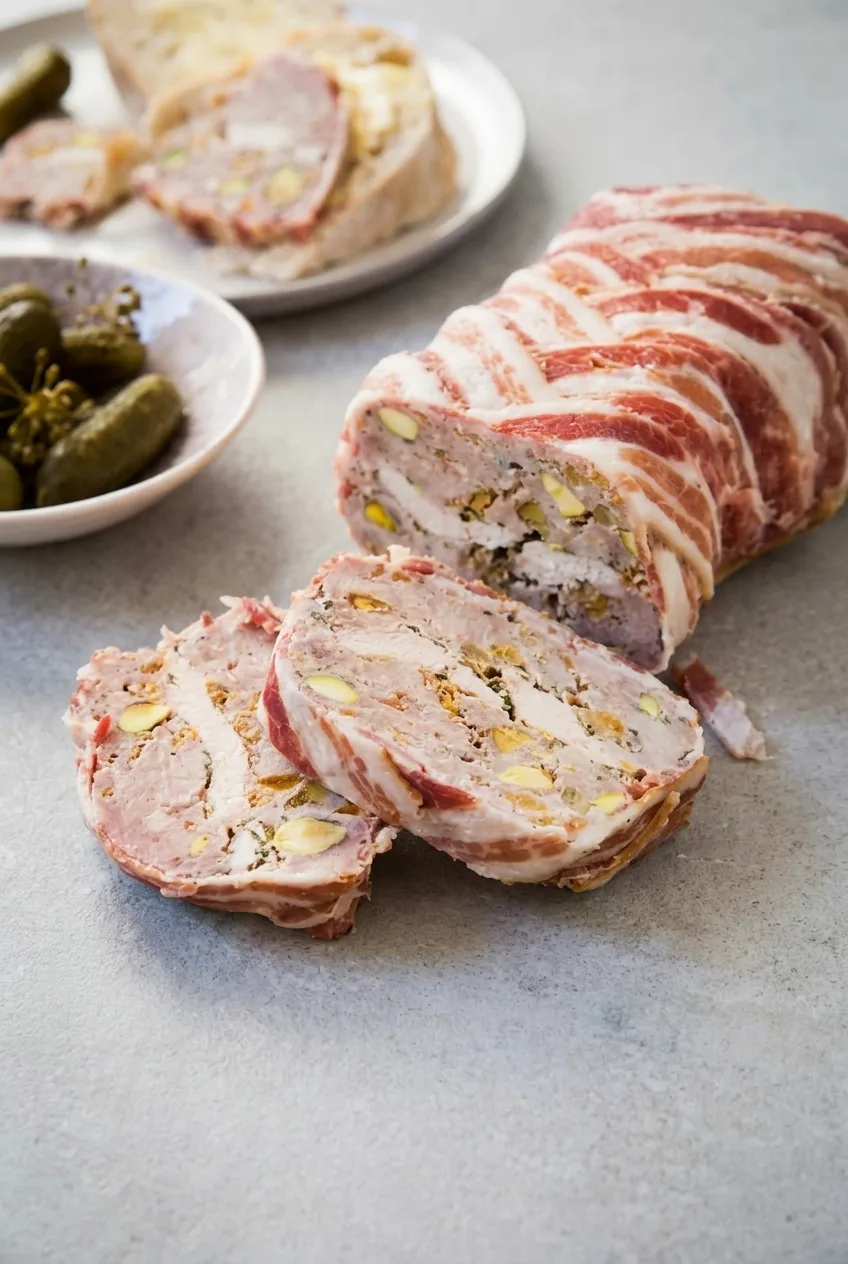
The bacon is what holds it together, so stretch each rasher with the back of a knife before it goes in. Lay them widthways on alternate diagonals with plenty overhanging, because those overhangs fold back over the top to seal it.
Hairy Bikers Pork Terrine Recipe
Description
Chicken breast strips marinate in white wine, lemon and thyme while shoulder and belly are minced with apricots and pistachios. The three layers bake in a water bath at a low heat, then the whole thing is weighted down and chilled overnight before it is turned out and sliced thickly.
Ingredients
For the Chicken Layer:
For the Pork Layers:
To Assemble:
Instructions
- Marinate the chicken: Slice the chicken breasts into strips, put them in a bowl and season. Add the white wine, lemon zest and thyme, drizzle over the oil, then cover and leave it for at least an hour.
- Mince the pork: Finely chop the pork shoulder and belly, or put the lot through a mincer or food processor. Tip it into a bowl with the lemon zest, thyme, ginger, apricots and pistachios, mix it well and season with salt and pepper.
- Line the mould: Heat the oven to 150°C/Fan 130°C/Gas 2. Stretch the bacon rashers with the back of a knife, then line a 1 litre terrine mould or loaf tin, laying them widthways on alternate diagonals so they overlap and hang over the sides.
- First pork layer: Put half the pork mixture into the mould and spread it out evenly.
- Chicken in the middle: Lift the chicken out of the marinade and mix it with the chopped parsley, then lay the strips over the pork in an even layer. Cover with the rest of the pork mixture.
- Seal the top: Fold the overhanging bacon back over the top, then add more rashers until the filling is completely covered.
- Bake in a water bath: Put the lid on or cover with a double layer of foil, sit the mould in a roasting tin and pour in just-boiled water to come 2cm up the sides. Bake for 1½ hours.
- Check and press: It is done when a probe reads 75°C, or when a skewer held in the centre for a few seconds is too hot to hold. Cover with a double layer of foil, weigh it down with a couple of tins, leave it to cool, then chill overnight before turning out and cutting thick slices.
FAQs
The two books use different amounts of chicken, which is right?
Both are, they just make different terrines. British Classics uses 200g of chicken in a 1 litre mould and says it serves six to eight. Chicken and Egg doubles the chicken to 400g, uses a 1.2 litre mould and says it serves four.
The pork is identical in both, 300g of shoulder and 300g of belly. So the choice is really about what you want the middle stripe to look like.
Less chicken gives a thin ribbon through mostly pork, more chicken gives a proper central band and a lighter terrine. If you are serving it as a starter, the British Classics ratio goes further.
Do I need a proper terrine mould?
No, and the recipe says so. A loaf tin does the job as long as it holds about a litre, because the bacon is doing the shaping rather than the tin.
Improvising is very much in keeping with these books anyway. The pork pie shapes its hot water crust pastry over four buttered jam jars turned upside down, which works better than most proper moulds. A terrine is easier than that, since you only need something the right size with straight sides.
Why does it bake sitting in water?
Because the mixture is essentially meat and fat with nothing holding it together, and direct oven heat would cook the outside long before the middle got anywhere. Water cannot go above 100°C, so it keeps the sides gentle while the centre catches up.
Use just-boiled water rather than cold, so the bath is already at temperature when the terrine goes in and the oven is not spending half an hour heating it up. Two centimetres up the sides is enough, and the recipe is specific about that.
Why weigh it down overnight?
This is the step that turns it from a meatloaf into a terrine. Pressing it while it cools sets the fat and juices under compression, so the layers bind into a single block that slices cleanly instead of crumbling apart on the board.
Cooling also firms the fat, which is why 300g of belly is in there. The pork belly recipe roasts that same cut whole to render the fat out and get crackling, which is the exact opposite job. Here you want the fat staying put and setting solid.
Can I make it the day before?
You have to, in fact. The overnight chill under weights is part of the recipe rather than optional storage, so the earliest you can serve it is the day after you cook it. That makes it one of the few dinner party dishes where getting ahead is compulsory rather than clever, like their twice-baked cheese souffles. And their prawn cocktail is the opposite kind of starter, since it is mixed an hour ahead at most and plated at the last minute.
It wants something sharp alongside, because a slice is rich. Rhubarb chutney is the obvious match and it shares the dried apricots that are in the terrine, though it needs two weeks in the jar so start it well ahead. Warm focaccia rather than toast is the other thing worth having, since a soft bread suits a cold slice better than something brittle, whereas their potted beef wants the toast.