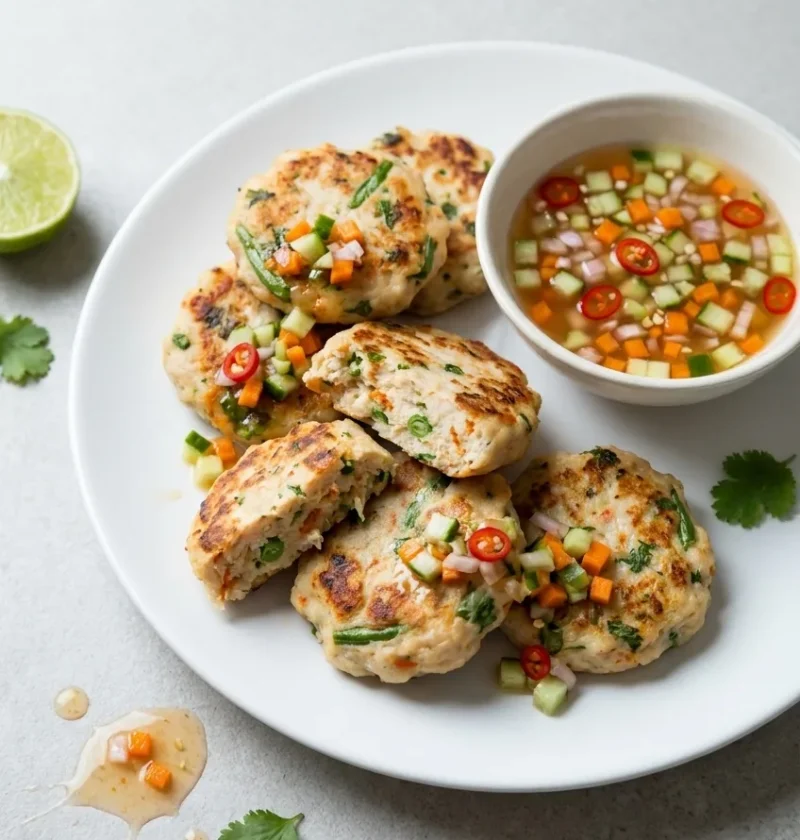
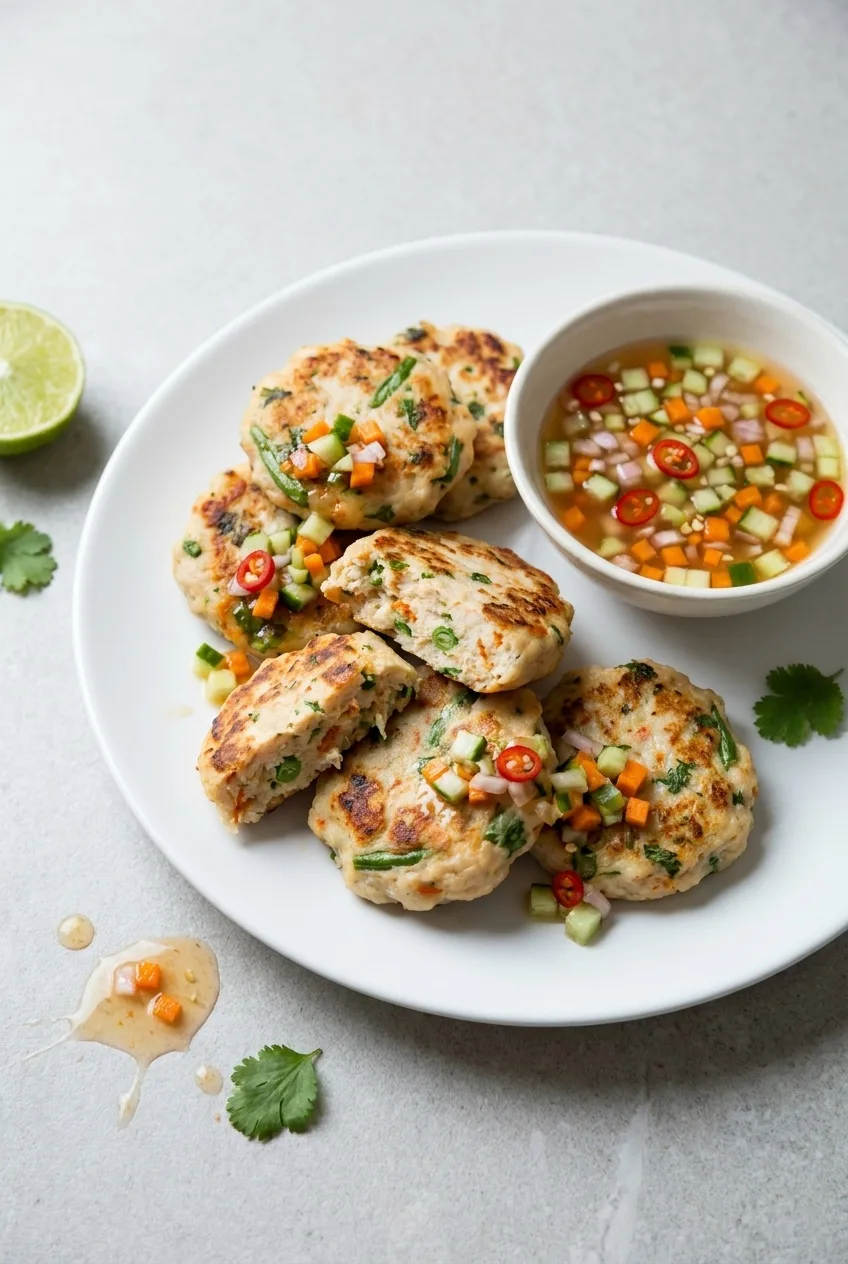
The mixture for Hairy Bikers thai fish cakes is far too wet to shape, and that is not a mistake. Sea bass gets blitzed with red curry paste, galangal and lime leaf in Asian Adventure, and 500g of fish makes 18 to 20 small cakes.
These started life in Great Curries and were reprinted because “the Thai tuk-tuk drivers loved them so much”. That is a better endorsement than most recipes carry, since they were judged by people who eat this food every day.
Wet hands are what makes the shaping possible, and Si and Dave call that the secret outright. Dip your palms in water before you touch the mixture, then the paste rolls into a ball instead of gluing itself to your fingers.
Hairy Bikers Thai Fish Cakes Recipe
Description
Everything for the cakes goes into a processor in one go, including the beans and the lime juice, and comes out as a loose paste that needs chilling before it will behave. The dip is whisked separately and then loaded with diced cucumber, carrot, shallot and bird’s-eye chilli. Shallow fried a few at a time.
Ingredients
For the Fish Cakes:
For the Honey and Cucumber Dip:
Instructions
- Prepare the lemon grass: Trim the stalk, pull off the outer leaves and slice the tender inner part.
- Blitz the mixture: Put the sea bass, fish sauce, curry paste, lime leaf, galangal, lemon grass, coriander, egg, palm sugar, beans and lime juice into a food processor and blitz to a paste. Take the lid off and push the mixture down with a spatula a few times as you go.
- Tip it out: Carefully remove the blade, then scrape the mixture into a bowl.
- Shape the cakes: Sprinkle a little flour onto a plate. Wet your hands, take a walnut-sized piece of the mixture, roll it into a ball and flatten it into a thin disc. Lay it on the floured plate and carry on until the mixture is used up.
- Chill them: Cover the fishcakes and put them in the fridge until you are ready to cook.
- Make the dip: Whisk the vinegar, honey, lime juice and fish sauce together with 2 tablespoons of water. Taste it and adjust the honey and lime depending on how sweet or sour you want it, then stir in the cucumber, carrot, shallot and chillies.
- Fry them: Heat the oil in a large non-stick frying pan and cook the fishcakes a few at a time for a couple of minutes, then turn and give them another 2 minutes until golden on both sides and cooked through.
- Serve: Drizzle a little of the dip over the fishcakes and pile some of the chunky bits on top.
FAQs
Does it have to be sea bass?
No. The recipe says outright that sea bass is great here but cheaper white fish works fine, so cod, haddock or pollock will all do the job.
What matters more is buying it skinned and pin-boned, or doing both yourself before it goes near the processor. The same applies to any white fish you swap in. And if you want a British fish cake built on mash and breadcrumbs rather than a blitzed paste, their salmon and dill fish cakes are the one, with the fish poached instead.
And for a second Asian starter from their books, their prawn spring rolls chop raw king prawn with water chestnuts and fry in rice wrappers.
My mixture is too wet to shape, have I done something wrong?
Almost certainly not. Si and Dave describe it as quite sloppy and give wet hands as the answer, so a paste that clings to everything is the normal outcome rather than a fault.
Two things help. Wet your palms again between every few cakes rather than once at the start, and get them all shaped onto the floured plate before any of them go in the pan. The chilling step firms them up considerably, so cakes that felt hopeless going into the fridge hold together fine coming out.
Snake beans and galangal, do I really need them?
The beans, no. The recipe offers fine green beans instead and they do the same job, which is putting flecks of green and a bit of bite through a smooth paste.
Galangal is different and worth tracking down. It looks like ginger and gets sold next to it, but it tastes sharper and more citrus than hot, so swapping in root ginger gives you a noticeably different cake. Most large supermarkets carry it frozen if the fresh has run out, and frozen is fine here since it is going in a processor anyway.
Bought curry paste or homemade?
Bought is fine and the recipe says so. Only 2 teaspoons go in, so this is not the dish to spend an afternoon pounding a paste for.
If you do want to make your own at some point, massaman curry builds its paste from scratch with cardamom, cumin, cloves, star anise and 30g of galangal, which is the same amount of galangal this recipe uses. That is a proper project though, and it is a curry rather than a garnish.
How far ahead can I make them?
Shape them and get them in the fridge whenever suits you, because the recipe treats chilling as a holding step rather than a timed one. An hour firms them up nicely and they will sit covered for several hours.
Beef rendang takes 75g of galangal and two lemon grass stalks, blitzed into a paste the same way this mixture is, so it is the obvious way to use up what is left over. For something quicker, salmon with chilli ginger sauce is another fish dish with an Asian marinade at 254 calories for four.