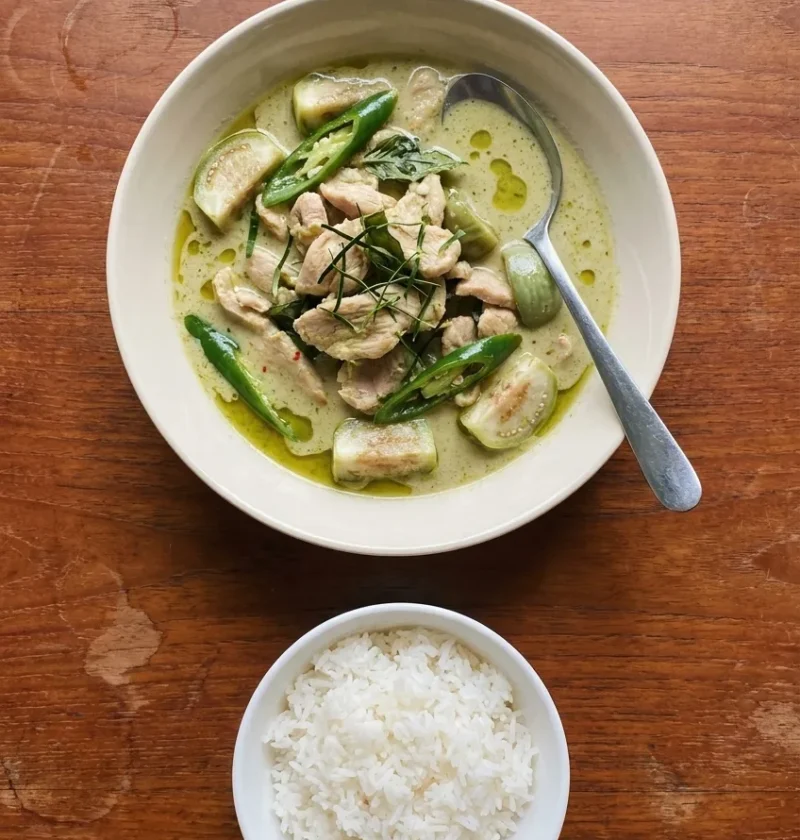
Hairy Bikers Thai green curry belongs to Auntie Daeng, a Bangkok chef who once cooked for the Thai royal family. With no times or calories in Asian Adventure, I make it about an hour for 4 bowls of roughly 570 calories each, before rice.
For all the pounding, Si and Dave still call her recipe “straightforward and so good”, and once the paste is made, I’d agree. Where a jar would do the work, she pounds 15 green chillies with salt, coriander root and shrimp paste, then grates in coconut cream.
Coconut milk goes in three rounds of 200ml, and each one is stir-fried with the paste until the wok is almost dry. So I stay at the wok stirring, because I find the paste only loses its raw edge once the milk has fried right down.
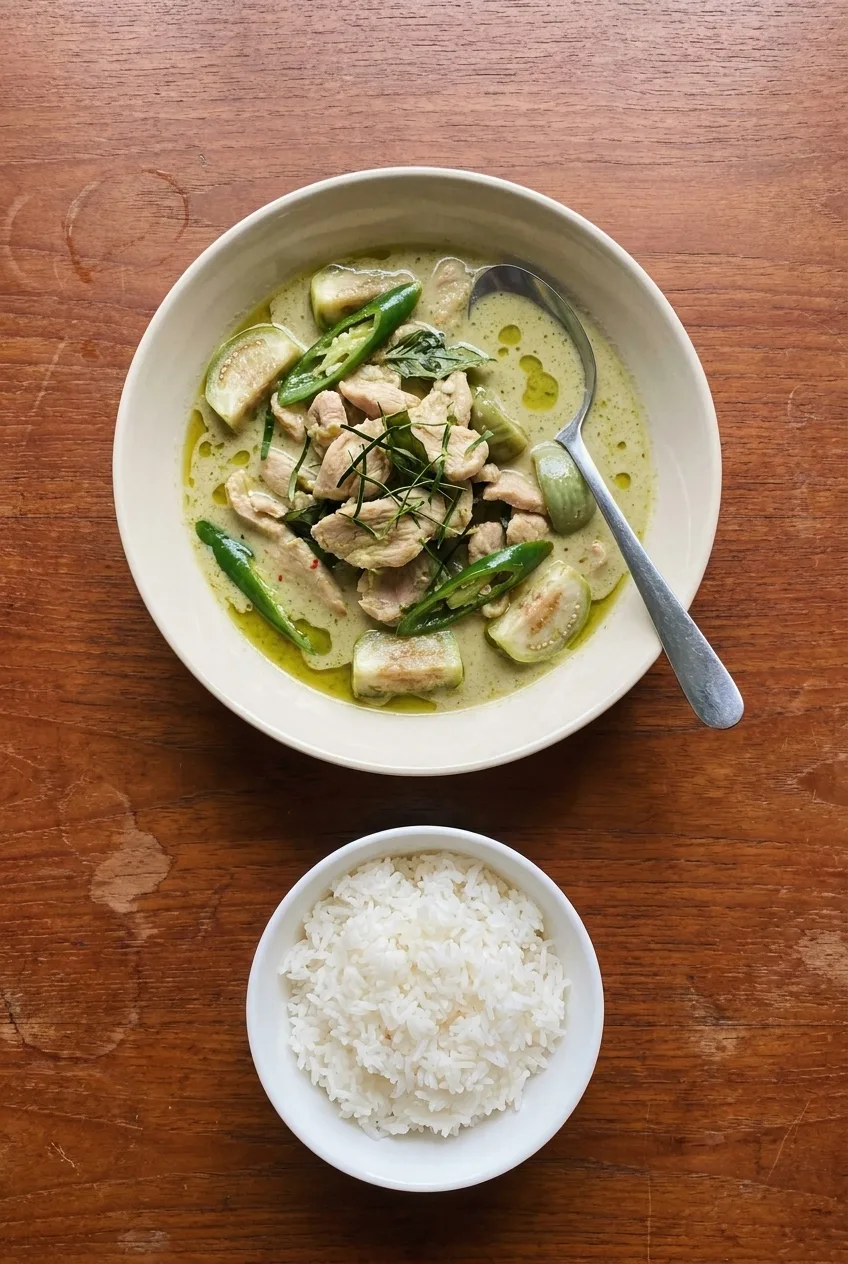
Hairy Bikers Thai Green Curry Recipe
Description
Fresh green chilli paste, pounded by hand or blitzed, is the start of this one-wok curry. Then it darkens as the coconut milk cooks into it, before meat or fish, coconut cream, palm sugar and small aubergines go in.
Ingredients
For the green curry paste
For the curry
Instructions
- Crush the seeds: Crush the coriander and cumin seeds with the white peppercorns in a pestle and mortar, then tip them out.
- Pound the chillies: Pound the green chillies with the salt to a paste, adding a few at first and tasting, since they vary in heat.
- Finish the paste: Pound in the galangal, lemon grass, lime zest and coriander root, then the crushed seeds. Add the garlic, shallots and shrimp paste and pound everything to a paste, or use a food processor.
- Fry the paste: Heat the vegetable oil in a wok, add 50g of the paste and stir-fry. Then add 200ml of the coconut milk and keep stir-frying until the pan is almost dry.
- Cook down the rest: Add another 200ml of coconut milk and cook it down the same way, then repeat with the last 200ml.
- Add the meat or fish: Stir in the meat, fish or prawns, then the grated coconut cream. Cover the pan until it comes to the boil.
- Season and simmer: Add the fish sauce, palm sugar, aubergines, long green chillies and lime leaves. Cook until the aubergines are soft and the meat or fish is cooked through, with no pink left in chicken or pork.
- Check and serve: Before serving, I check the thickest piece of chicken holds 70°C for 2 minutes. Then scatter with Thai basil and serve with Thai rice.
FAQs
Can I use shop-bought Thai green curry paste?
Yes, since Si and Dave write “obviously you can use shop-bought curry paste if you prefer” about their Thai vegetable curry. With a jar, I’d still start at 50g and taste, because brands vary in heat as much as fresh chillies do.
I find her homemade paste comes to a lot more than 50g, so I freeze the rest in small tubs. So do Si and Dave with their massaman curry, making enough paste for two curries and freezing the rest for up to a month.
Is there a diet Thai green curry?
Yes, and Si and Dave lightened one for the original Hairy Dieters book, using 2 heaped tablespoons of green or red paste from a jar. At 286 calories a portion without rice, it simmers chicken breast, peppers and mangetout in half-fat coconut milk loosened with 250ml of water.
They’d cook no more than 50g of rice per person with it, and cut the paste to level spoonfuls for a milder curry. When they printed it again in Great Curries, they added that they like it with chicken thighs or firm white fish such as monkfish.
Can I make a Thai green vegetable or fish curry?
Fish and raw prawns are already on Auntie Daeng’s list, so a Thai green fish curry needs no changes. But I’d slice firm white fish thinly, as Si and Dave advise for their lighter version, so it cooks quickly and thoroughly.
It isn’t vegetarian as written, because of the shrimp paste and fish sauce. For a meat-free one, Si and Dave season their Thai vegetable curry paste in Eat to Beat Type 2 Diabetes with soy sauce.
What are apple aubergines, and what can I use instead?
They’re small round Thai aubergines, sold in Asian stores, and pea aubergines are smaller still. But their method also allows aubergine pieces, which is what I use when the Asian shop is out.
Without Thai basil, a mix of ordinary basil and coriander is the swap Si and Dave suggest in Eat to Beat.
Who is Auntie Daeng?
She’s Chef Chanchavee Skulkant, though everyone calls her Auntie Daeng. By the time of Asian Adventure, she was running a little restaurant in Bangkok, serving traditional food at very reasonable prices.
Her stir-fried crab with yellow chillies is the only other dish of hers in the book. For a starter, I’d go for the sea bass Thai fish cakes from the same book. Or for a slower Sunday dish, their Thai pot roast chicken braises a whole bird in a red curry coconut sauce.