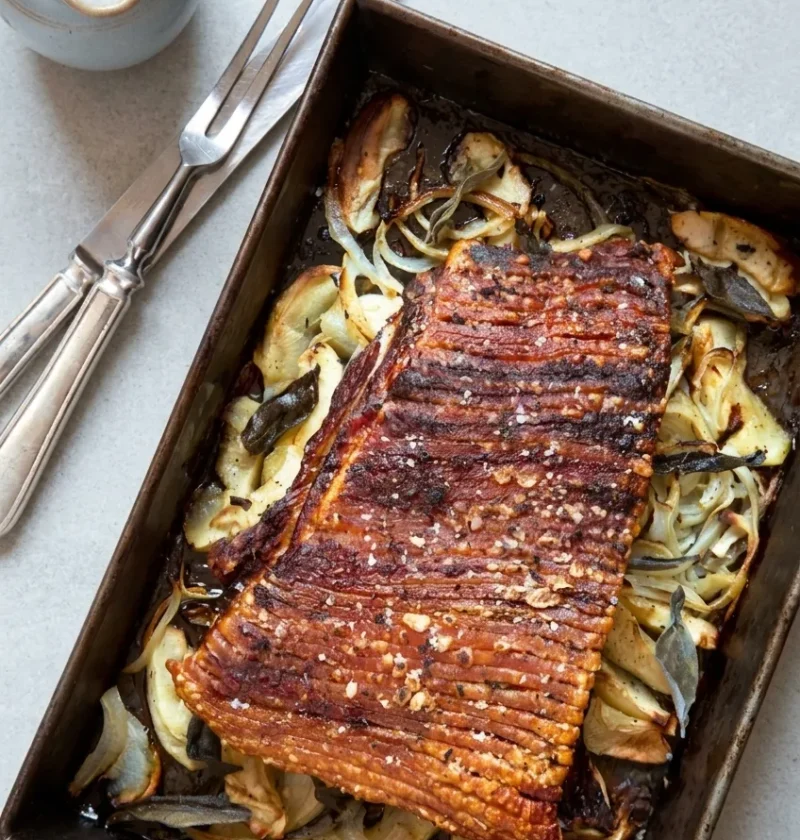
Hairy Bikers pork belly with apples and sage turns up in two cookbooks, Meat Feasts and Mums Still Know Best. Both roast 1.5kg of belly of pork over 2 hours 50 minutes, so it feeds four to five at 875 calories.
Si and Dave keep it short in Mums Still Know Best: “This recipe is brilliant! Enough said.” They say more in Meat Feasts, where what you want is “crisp crunchy crackling and melt-in-the-mouth tender meat underneath”. The difference is the apples, since one book peels and cores them while the other leaves the skins on.
Crackling depends on the rind being properly dry before it goes in, so pat it with kitchen paper first. The 240°C blast then has 25 to 30 minutes to bubble the skin, while any damp left on it turns to steam instead.
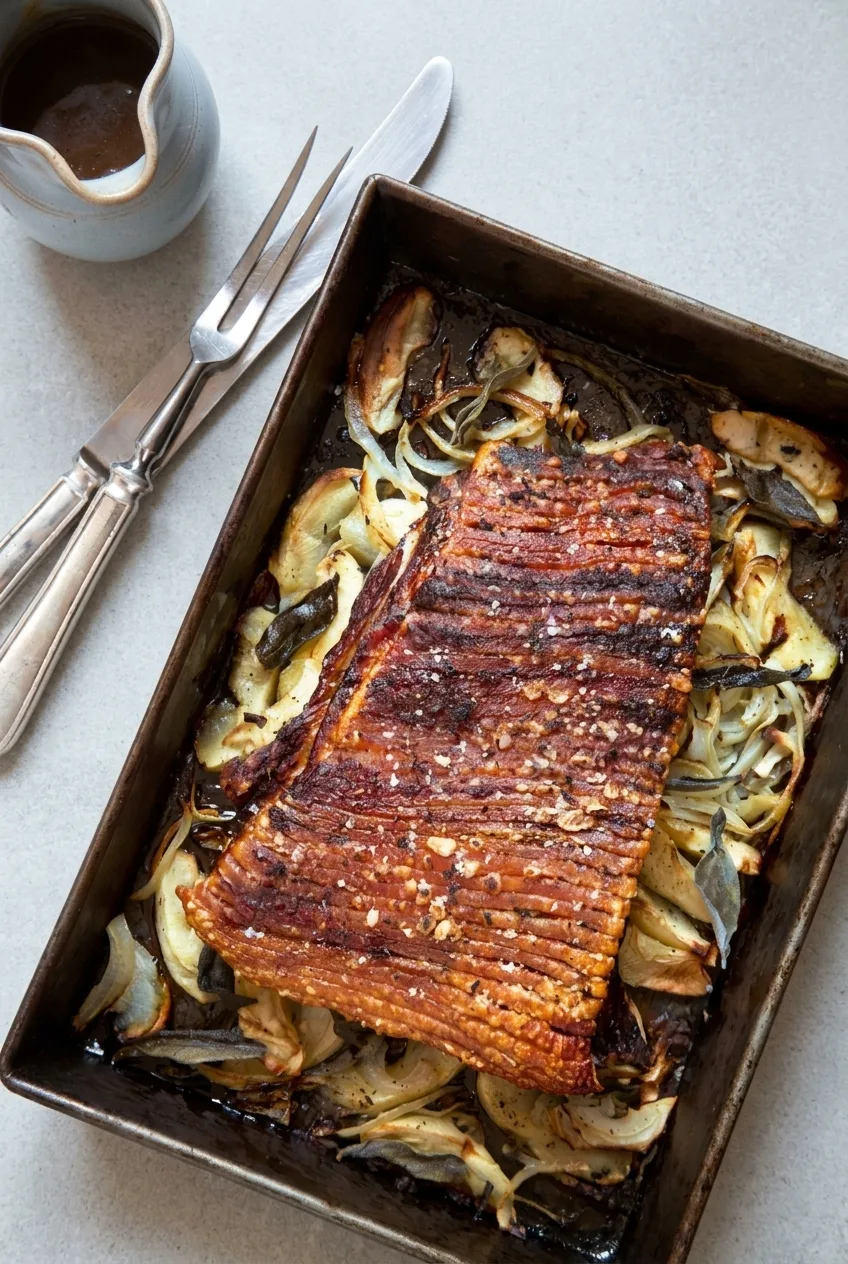
Hairy Bikers Pork Belly Recipe
Description
The belly starts hot enough to blister the rind, drops to a moderate heat for an hour, then spends a final hour sitting on a pile of onion and sage. Cider and the tin juices turn into the gravy, and it carves straight away with no resting.
Ingredients
For the Pork:
For the Apples and Onions:
For the Cider Gravy:
Instructions
- Dry and season: Heat the oven to 240°C/Fan 220°C/Gas 9, then pat the pork rind dry with kitchen paper. Mix the thyme, salt and pepper together and rub it into the rind, then turn the belly over and rub it on the underside too.
- Blast the rind: Sit the pork in a sturdy roasting tin and roast for 25 to 30 minutes, so the rind bubbles up and turns really crisp.
- Drop the heat: Turn the oven down to 180°C/Fan 160°C/Gas 4 and carry on roasting for another hour.
- Pile up the apples: Toss the apples with the onions, whole sage leaves and a few twists of pepper, then make a compact pile in the middle of a second, smaller roasting tin.
- Move the pork: Lift the pork out and sit it on top of the pile, keeping the apple and onion tucked underneath the meat so they do not burn. Keep the first tin to one side, because those juices are the gravy.
- Finish the roast: Put the pork back in the oven for a further hour, until the meat underneath is really tender.
- Make the gravy: Skim the fat off the juices in the first tin, then set it over a medium heat and stir in the flour. Cook for a minute, then gradually stir in the cider and 100ml water and simmer for 3 to 4 minutes before straining it into a small pan.
- Carve and serve: Move the pork to a board and spoon the apple and onion into a warm bowl. Reheat the gravy until it bubbles, then cut the pork and crackling into thick slices and serve.
FAQs
Why does this need two roasting tins?
Because the gravy is made from clean juices. The first hour and a half of dripping is pure pork fat and seasoning, and if you tipped apples and onions into that same tin, the fruit would burn in the fat and turn the gravy bitter.
Moving the pork to a fresh tin keeps the two jobs apart. The apples cook gently in the meat juices that fall during the final hour, while the first tin sits to one side holding everything you need for the cider gravy.
Is this a slow roast pork belly?
Not really, and that catches people out. The oven never drops below 180°C and the whole thing is done in about two and a half hours, so it is a fast roast by pork belly standards.
There is a genuinely slow one in Ultimate Comfort Food, which sits at 160°C for two and a half hours before a blast at 220°C to crisp the skin. Different book, different dish. If low and slow is what you want, the slow roast leg of lamb goes even further, wrapped in foil for four to five hours before it gets its ten minutes of high heat.
What do I do if the crackling comes out soft?
Cut it off the joint and put it under a hot grill on its own for a few minutes, watching it constantly because it goes from pale to burnt very fast. It will still crisp up, since the fat underneath has already rendered by then.
Scoring matters as much as drying does. Ask the butcher to score it deeply rather than cutting shallow lines yourself, because the cuts need to reach down into the fat for it to render out and push up through the skin.
Should the apples be peeled or left whole?
The books disagree, which is useful to know. Mums Still Know Best says to peel, quarter and core them, while Meat Feasts just says cut them into thick slices. Both work, so it comes down to what you want from them.
Skins on and the slices hold together better under the weight of the pork, while peeled ones collapse into something closer to a sauce. Use eating apples either way, because cooking apples turn to complete mush in an hour. Save the Bramleys for something like apple pie, where you actually want them to break down.
Can I cook a side dish at the same time?
Yes, and the timing lines up neatly. The oven sits at 180°C for the last two hours, which is exactly what cauliflower cheese wants for its 30 minute bake, so it can go in alongside the pork for the final stretch.
Something sharp is worth having on the table too. Rhubarb chutney does that job well against fatty pork, though it needs two weeks in the jar before it is ready, so that one is a make-ahead rather than a same-day thing.