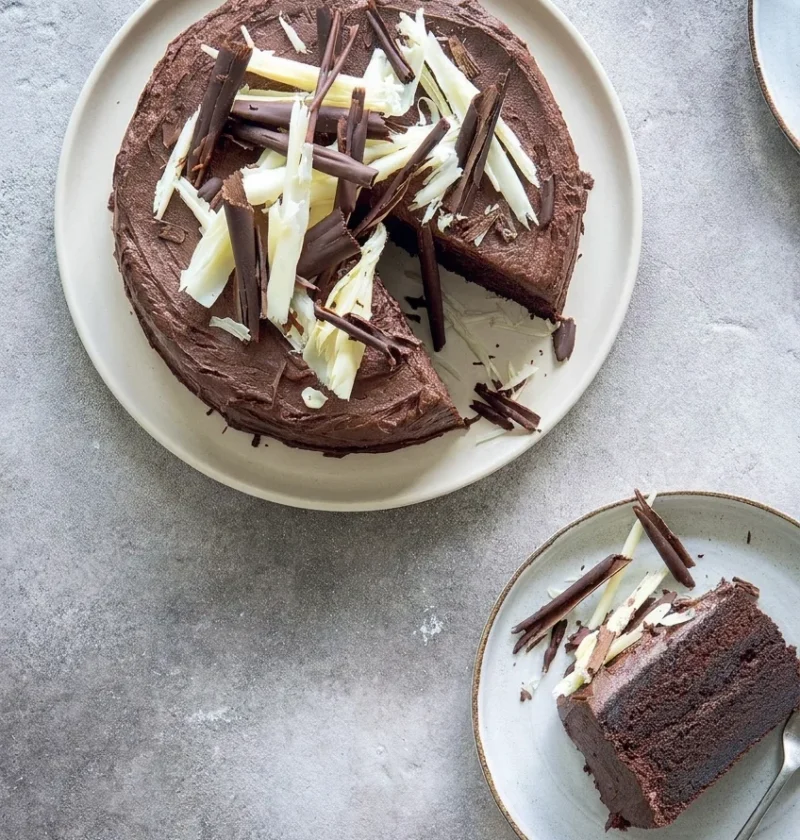
Hairy Bikers chocolate cake exists because readers kept asking for one, and the book says so outright. It is in Everyday Winners, where two 20cm sponges serve eight to ten, and the whole thing comes together in about 2 hours.
What lifts it above a standard sponge is that both cocoa and dark chocolate go in, dissolved together in just-boiled water. Si and Dave are firm about one thing in Everyday Winners: “be sure to use proper cocoa powder, not drinking chocolate”.
That liquid goes in with everything else at the end, and the instruction is to keep mixing to a minimum. Overworking it develops the flour and you lose the rise, so stop as soon as the batter looks even.
Hairy Bikers Chocolate Cake Recipe
Description
Butter and brown sugar are creamed until properly aerated, the eggs go in one at a time, and then everything else follows in a single addition. The batter should pour rather than drop. Two sponges get sandwiched with a third of the buttercream and the rest goes over the top and sides.
Ingredients
For the Cake:
For the Buttercream Icing:
To Decorate, optional:
Instructions
- Line the tins: Heat the oven to 180°C/Fan 160°C/Gas 4 and line two 20cm sandwich tins with baking parchment.
- Melt the chocolate: Put the chocolate and cocoa in a bowl and pour over the hot water. Whisk until the chocolate has completely melted and you have a smooth liquid, then set it aside.
- Mix the dry ingredients: Whisk the flour, baking powder, bicarbonate of soda and salt together.
- Cream and combine: Beat the butter and sugar until very soft and aerated, then beat in the eggs one at a time. Add everything else, including the chocolate liquid and the flour mixture, and combine while keeping mixing to a minimum. You want a rich, pourable batter.
- Bake them: Divide the batter between the tins and bake for 25 to 30 minutes, until well risen and springy to the touch. Leave the cakes in their tins for 10 minutes, then turn them out onto a wire rack to cool.
- Melt the icing chocolate: Put the chocolate, cocoa and water in a bowl set over a pan of simmering water and stir until melted, then add the vanilla. Take it off the heat and leave it to cool slightly.
- Beat the buttercream: Beat the butter until soft and aerated, add the icing sugar and a pinch of salt and beat until smooth. Pour in the chocolate mixture and beat to combine, adding up to 2 tablespoons of milk if it is very stiff.
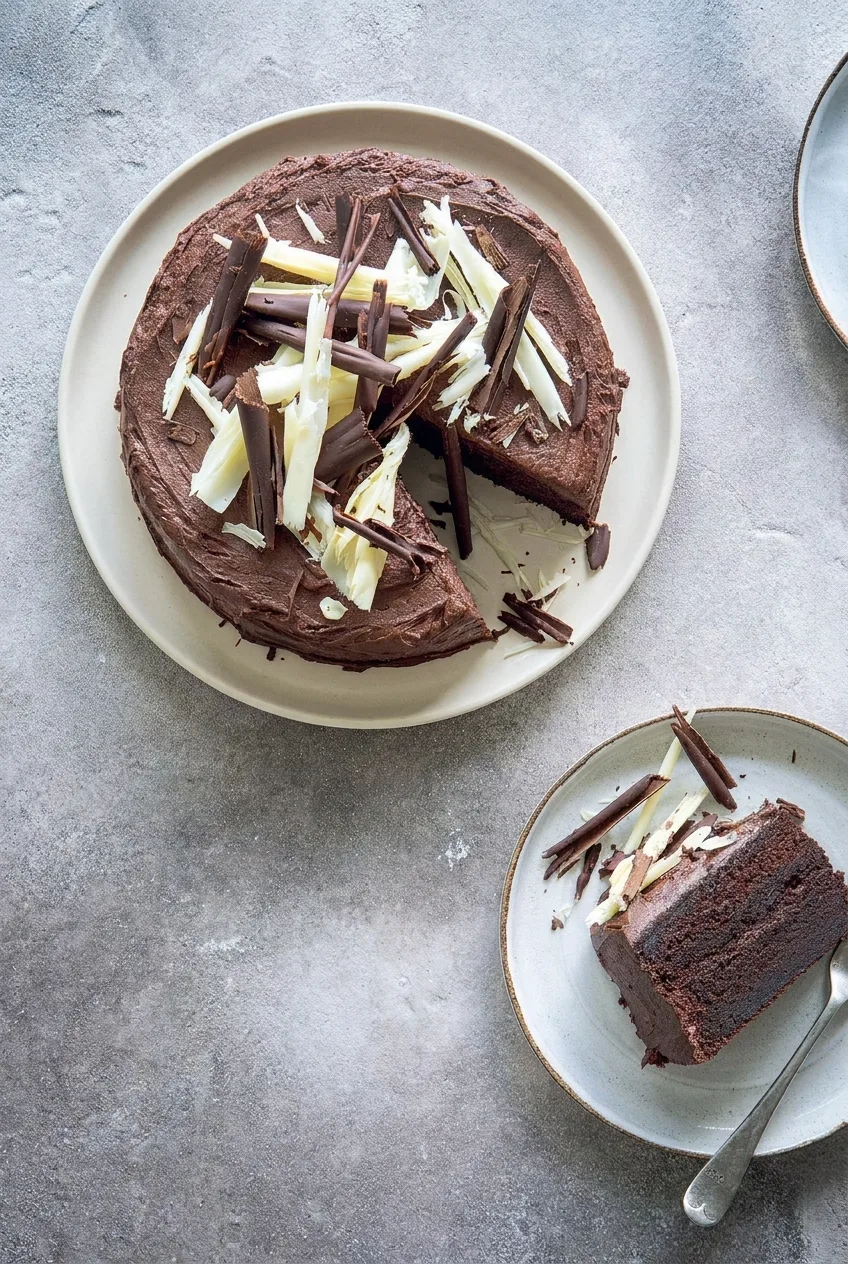
- Fill and cover: Spread a third of the icing over one cake and sit the other on top, then spread the rest over the top and sides. Leave it to set before serving, and add chocolate curls if you like.
FAQs
Cocoa or drinking chocolate, does it really matter?
Enough that Si and Dave flag it in the headnote rather than leaving it to chance.
The recipe leans on cocoa twice, 25g in the sponge and another 50g in the icing. That is 75g of it doing serious work, and drinking chocolate is a sweetened milk drink rather than a baking ingredient. Si and Dave rarely bother flagging a substitution in a headnote, so when they do it is worth taking seriously.
Why melt the chocolate in water rather than butter?
Because the same 250ml of water melts the chocolate and disperses the cocoa in one go, and that liquid then counts as the cake’s wet ingredient rather than being extra.
Not every chocolate cake works this way. The black forest gateau uses 65g of cocoa powder and no melted chocolate at all, whisked in dry with the flour and baking powder. Two different routes to a chocolate sponge, and worth knowing which one you are following before you start swapping things.
The book says 35 to 40 minutes but the method says 25 to 30
Go with the method. The header on the page gives 35 to 40 as the cook time, while step 5 says bake for 25 to 30 minutes, and the difference matters in a cake this rich.
Trust the cue rather than either number. Well risen and springy to the touch is what you are after, and start checking at 25. Two thin sponges in 20cm tins bake much faster than one deep cake, and an overbaked chocolate sponge goes dry in a way the icing cannot rescue.
Could I use oil instead of butter?
The creaming stage rules it out. 200g of softened butter gets beaten with the sugar until very soft and aerated, and that trapped air is doing half the lifting. Oil cannot hold air the same way, so this is a different recipe rather than a substitution.
If oil is what you want, the banana and pineapple cake is built for it, whisking the eggs and sugar until airy and then beating in 175ml of sunflower oil. Same two-tin format, completely different route to getting the sponge up.
How much icing does this actually make?
More than you might expect, and it is meant to cover the sides as well as the middle and top. A third goes between the layers and the remaining two thirds covers everything else.
It is the same volume the coffee and walnut cake uses, 150g of butter beaten with 300g of icing sugar, so if you have made that one you know what you are dealing with. Add the milk a little at a time only if it is genuinely too stiff to spread, since a loose buttercream will slide off the sides.