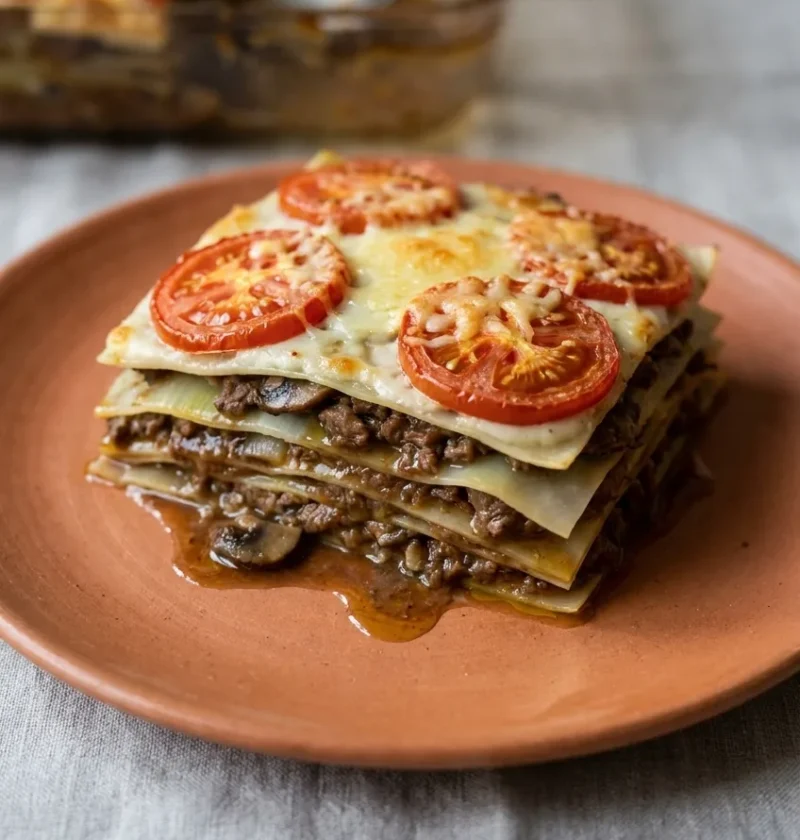
This Hairy Bikers leek lasagne from the Hairy Dieters swaps every pasta sheet for blanched leek leaves at 354 calories per serving. The ragù still has red wine, mushrooms, and a cornflour white sauce though, so nothing about it tastes like diet food.
The headnote says this “fools your eyes as well as your belly” because the baked leek layers look like pasta once they sit under the white sauce and cheese. Even the trimmings earn their place, since the thin inner leaves get sliced into the ragù so nothing goes to waste.
The mince browns in a dry non-stick pan without any added oil, because 500g of lean beef releases enough fat on its own within about 10 minutes. That change alone saves roughly 120 calories and is what makes this a Dieters recipe rather than just a lasagne with leeks.
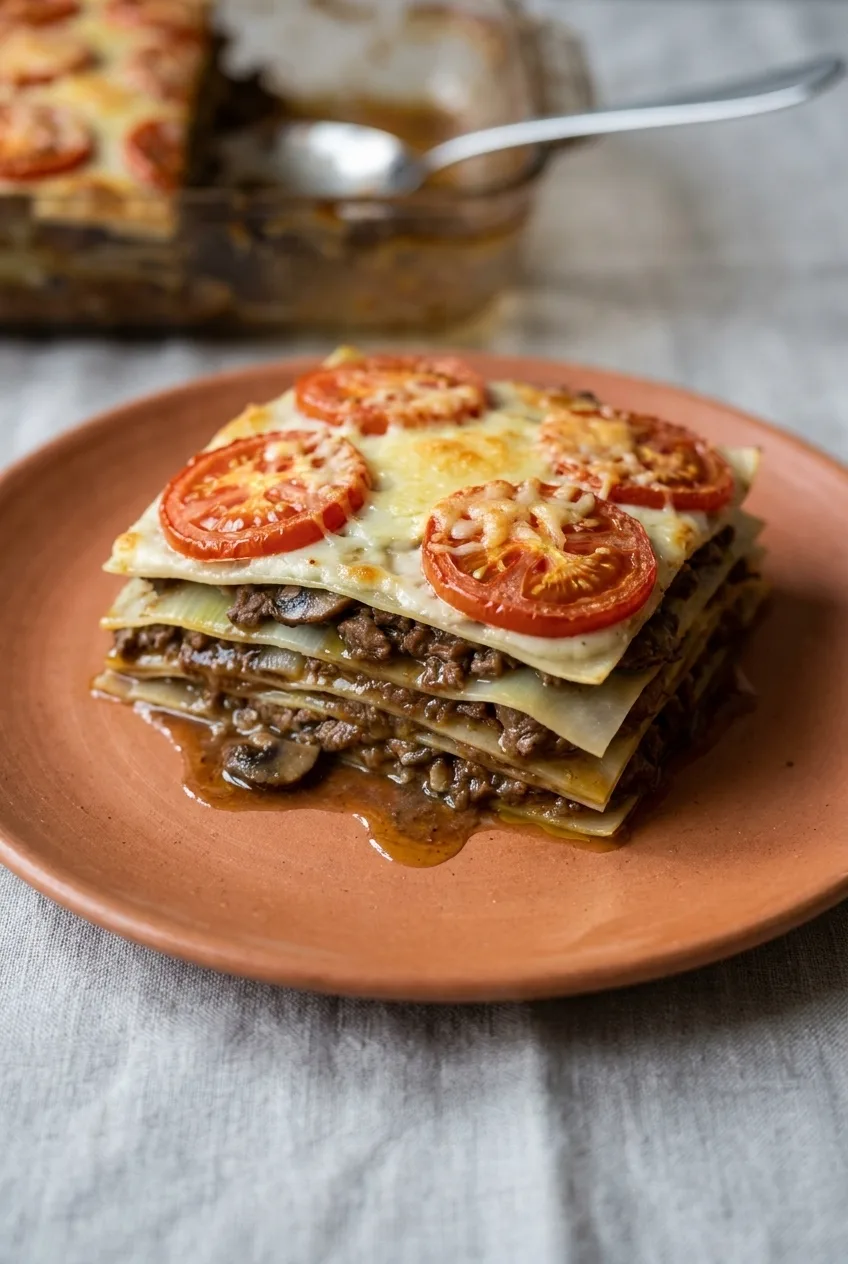
Hairy Bikers Leek Lasagne Recipe
Description
Six portions of proper beef lasagne for under 360 calories each, with blanched leek sheets standing in for the pasta. The cornflour white sauce skips the butter, sliced vine tomatoes replace heavy cheese on top, and the whole thing bakes in 30 minutes.
Ingredients
For the Leeks:
For the Meat Sauce:
For the White Sauce:
To Finish:
Instructions
- Prepare the leeks: Trim the leeks to roughly the width of your lasagne dish, then cut each one lengthways through to the middle but no further. Open them out and remove 5 or 6 of the narrow inner leaves from the centre, then thinly slice these for the ragù. Separate the larger outer leaves and set them aside because these become your lasagne sheets.
- Brown the mince: Put the lean mince in a large non-stick pan with the sliced inner leek leaves, chopped onion, celery, carrots, and garlic. Fry over a medium-high heat without adding any oil or fat for about 10 minutes until lightly coloured, breaking the mince up as it cooks. Stir in the mushrooms and cook for 2 to 3 minutes more until the pan looks fairly dry.
- Build the ragù: Sprinkle the flour over the mince and stir it through, then slowly pour in the wine and stock. Add the tomatoes, puree, oregano, and a bay leaf, then bring to a simmer and season with plenty of black pepper. Turn the heat down slightly and leave to simmer for 20 to 30 minutes until the sauce is rich and thick.
- Blanch the leek sheets: While the ragù simmers, bring a large pan of water to the boil and cook the leek leaves for 5 minutes until very tender. This step is important because undercooked leeks make the finished lasagne almost impossible to cut neatly. Drain under cold running water, then lay them flat on kitchen paper or a clean tea towel to dry.
- Make the white sauce: Put the onion wedges and remaining bay leaf in a saucepan with the milk and bring to a gentle simmer for 2 to 3 minutes, then remove from the heat and leave to infuse for 10 minutes before straining. Mix the cornflour with 3 tablespoons of cold milk until smooth, pour it into the infused milk, and bring back to a simmer for 5 minutes, whisking until thick. Season with nutmeg and pepper.
- Assemble and bake: Preheat the oven to 200°C/Fan 180°C/Gas 6. Spoon a third of the mince into a 2.5-litre lasagne dish, then top with a layer of blanched leeks. Repeat twice more, finishing with leeks. Pour the white sauce over the top, arrange the sliced tomatoes on the surface, then mix the Cheddar and Parmesan together and sprinkle over everything. Bake for 30 minutes or until golden brown and bubbling.
FAQs
How do I prepare the leeks so they work as pasta sheets?
Trim each leek to the width of your dish, then cut lengthways through to the centre without going all the way through. Open it like a book and pull out the 5 or 6 narrow inner leaves from the core, since these are too thin for sheets. Slice them thinly for the ragù instead, and the wider outer leaves peel away in flat pieces that lay across the dish like pasta once blanched.
The blanching cannot be rushed, because leeks need a full 5 minutes in boiling water to go properly tender. If they are even slightly underdone, the layers will slide apart when you try to cut a portion and the whole thing collapses on the plate.
Why does the mince brown without any oil?
Lean minced beef contains enough fat to fry properly in a non-stick pan without any oil, and skipping that step saves roughly 120 calories across the whole dish. The mince takes about 10 minutes to colour, which is slightly longer than with oil because the pan needs time to render the fat first.
The trick is resisting the urge to stir constantly, because the mince needs contact with the hot surface to form a crust. Breaking it up too early drops the temperature and the beef steams rather than browns, which gives a grey, watery result.
How many calories does this actually save?
Each serving comes in at 354 calories, which is less than half the 780 in the beef lasagne that uses pasta, ricotta, and mozzarella. The biggest savings come from removing the pasta at roughly 120 calories per portion and switching to a cornflour white sauce with no butter. Browning without added fat and using semi-skimmed milk saves another 100 on top.
The Eat to Beat Type 2 Diabetes cookbook pushes further with a roast vegetable version at just 241 calories when built with leek sheets. That version uses low-cal oil spray and reduced-fat Cheddar, so it is the lightest lasagne across all the cookbooks.
Why is there cornflour instead of butter and flour?
A traditional roux starts with 60g of butter and 60g of flour, which adds roughly 430 calories before the milk goes in. This recipe skips the butter and uses cornflour mixed with cold milk to thicken the sauce instead, so the white layer costs a fraction of the calories.
The result is slightly thinner and glossier than a butter-based béchamel, but it coats the leek layers and sets during baking. Infusing the milk with onion wedges gives it a depth that the missing butter would normally provide, and a good grating of nutmeg bridges the gap so nobody notices the sauce is lighter.
Can I use the leek sheets with a vegetable filling?
Yes, and the Eat to Beat Type 2 Diabetes cookbook has a roast vegetable version at 241 calories built entirely with leek sheets instead of pasta. The roasted vegetable lasagne from Veggie Feasts shows how the filling works if you want to try that combination with regular pasta first.
Blanch the leek sheets the same way and layer them between whatever filling you choose. Just make sure the filling is thick, because leeks release some liquid during baking. Any extra moisture on top of that quickly turns the bottom layer soggy.