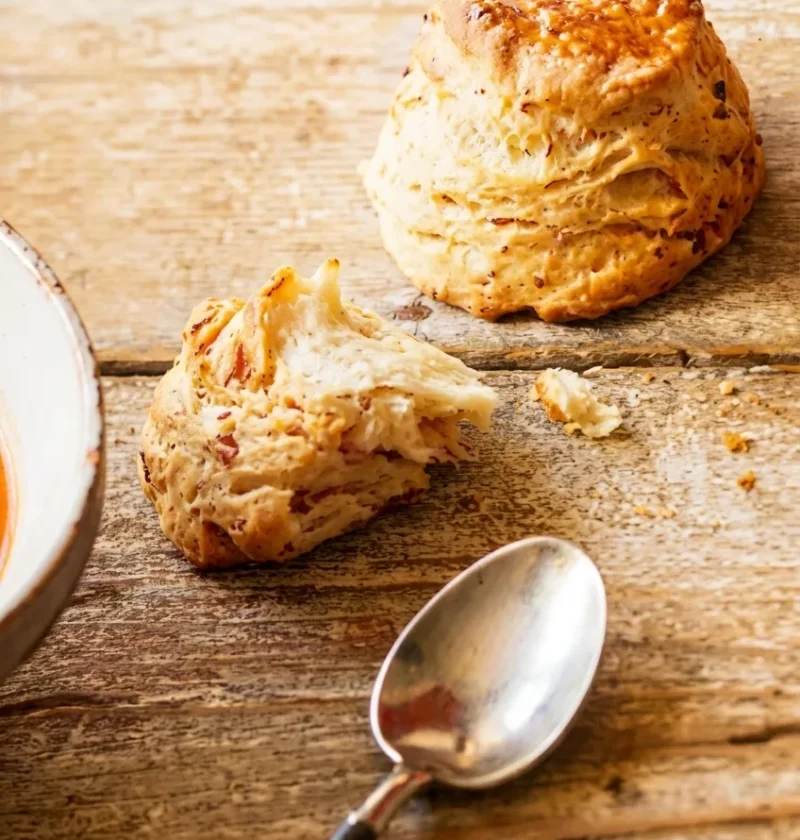
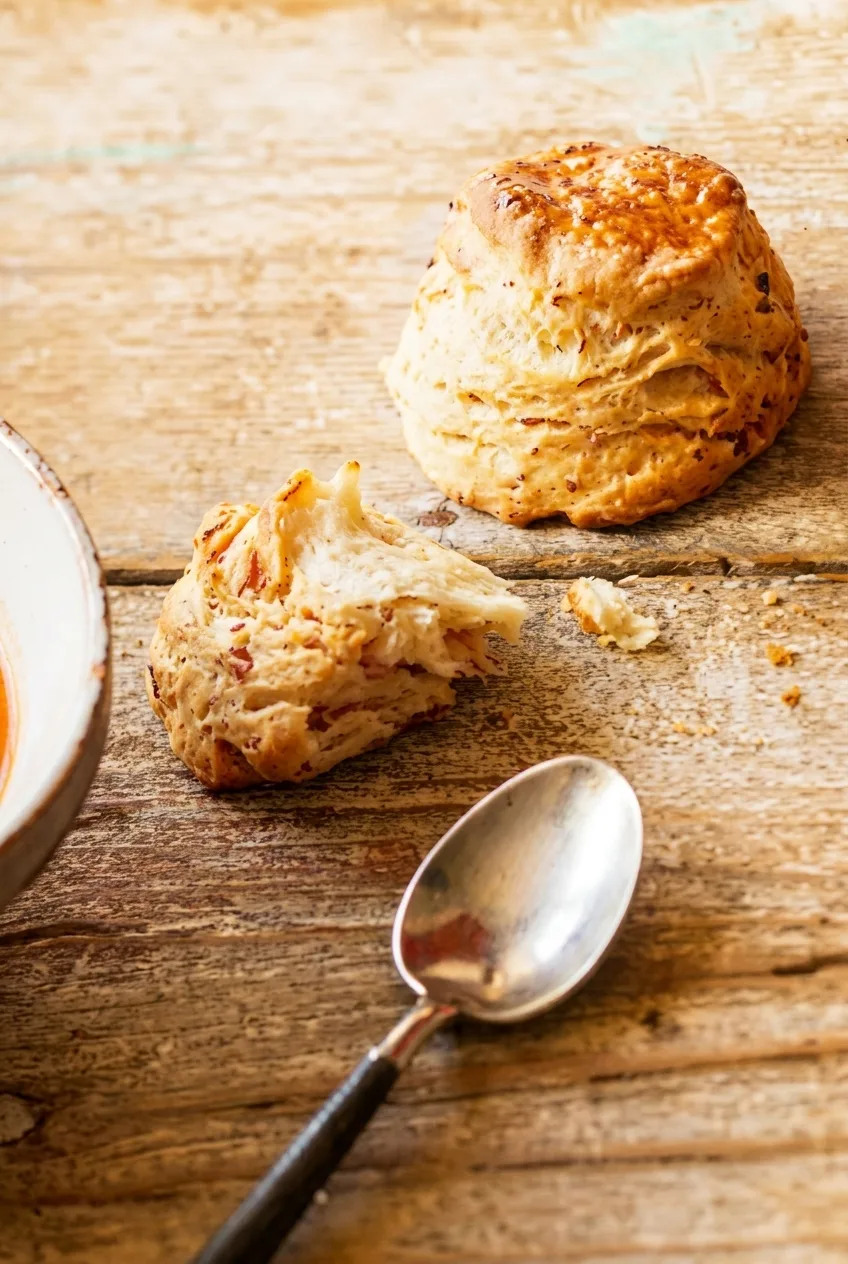
Hairy Bikers bacon scones are made with yeast, which is what separates them from every other scone in their books. Big Book of Baking publishes them as pogacsa, built on 250g of streaky bacon, soured cream and caraway seeds. It makes 12 at roughly 340 calories each.
They write that pogacsa turns up in Hungarian fables as the food a young man packs when he leaves to conquer the world. The recipe sits opposite their beef goulash soup in the book, because the two were always meant to be eaten together.
Three hours is the honest answer on timing. Only about half an hour of that is work, since the dough proves for ninety minutes and then rests another thirty after cutting, but it is not a bake you start at five o’clock.
Hairy Bikers Bacon Scones
Description
A criss-cross is scored on top of each round with a sharp knife, which is how you recognise pogacsa on a Hungarian table. The dough carries crisp bacon, Parmesan, caraway and soured cream. These Hairy Bikers bacon scones bake for 25 to 30 minutes.
Ingredients
Instructions
- Start the yeast: Gently heat the milk until lukewarm, pour it into a jug and stir in the yeast. Leave it for 15 minutes or so to froth up.
- Fry the bacon: Meanwhile, heat a heavy-based pan and fry the bacon until crisp and golden. Lift it out and leave it to cool.
- Mix the dry ingredients: Sift the flour into a bowl and mix with the baking powder and salt. Stir in the Parmesan and caraway seeds.
- Melt the butter: Melt the butter in a small pan over a gentle heat until just liquid. Take it off the heat, stir in the soured cream, then add the beaten eggs. Make sure the butter is not too hot or the eggs will scramble.
- Combine: Add the cooled bacon and stir in the yeasty milk. Pour this mixture into a large bowl, then add the dry ingredients a little at a time until everything comes together.
- Knead and prove: Turn out onto a floured surface and knead for about 5 minutes until elastic, or use a mixer with a dough hook. Put the dough in a lightly oiled bowl, cover with oiled clingfilm and leave somewhere draught-free for about an hour and a half, until doubled in size.
- Shape and rest: Knock the dough back with your knuckles. Dust with flour and roll out to about 4cm thick. Cut out rounds and place them on baking parchment on a tray. Score a criss-cross pattern on each top with a sharp knife, then leave to rest for another 30 minutes.
- Bake: Preheat the oven to 200°C, fan 180°C, gas 6. Brush the scones with beaten egg mixed with a drop of water and bake for 25 to 30 minutes, until golden. Eat warm, split and buttered.
FAQs
Are these really scones?
Not in the British sense. A scone is rubbed together and baked straight away, while these are yeasted, kneaded for five minutes and proved twice, which puts them closer to a bread roll.
Pogacsa is what Hungary calls them, and the book keeps that name in brackets. For the quick version, their cheese and Marmite scones use 300g of flour and are on the table in 35 minutes rather than three hours.
Why both yeast and baking powder?
Because they lift at different times. Yeast works slowly during the two rises and builds flavour as it goes, while the teaspoon of baking powder fires in the oven heat and gives a last push.
Most doughs use one or the other. Having both is what gives these their texture, lighter than a bread roll but sturdier than anything rubbed together.
What are the caraway seeds doing?
Anchoring the flavour to a place. Caraway runs through the cooking of central and eastern Europe, and a tablespoon is enough to make these taste of somewhere rather than of nothing in particular.
They also match what you eat them with. Their goulash soup uses two tablespoons of crushed caraway and finishes with soured cream, the same two flavours as this dough, and the book prints the recipes facing each other.
Why score the tops?
The criss-cross is traditional and it is how pogacsa is recognised. It also gives the dough a place to open, so the tops crack neatly rather than splitting wherever they like.
Score after cutting and before the 30 minute rest, with a sharp knife and a light hand. Too deep and the round collapses while it proves. Their fruit scones need no scoring at all, because nothing in that dough is still rising once it hits the tray.
Can I use pork crackling instead of bacon?
The book says you can, and that Hungarians often do. It also says crackling gives a heavier scone, and that they prefer bacon when the soup is on the table.
Take that as a recommendation rather than a rule. If you use crackling, chop it small so it spreads through the dough, since larger pieces sink in a mixture this rich.