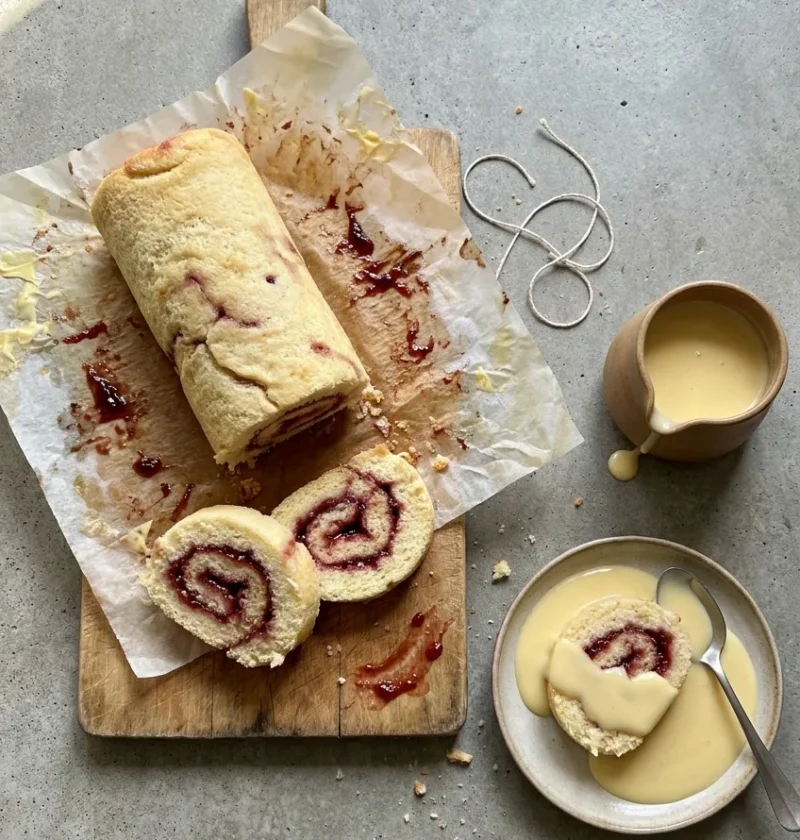
Wrapped in pleated paper and foil, twisted at the ends like a Christmas cracker, the Hairy Bikers jam roly poly bakes inside its own parcel. What comes out is a risen suet sponge with jam spiralled through every slice.
British Classics keeps it to “simple store-cupboard ingredients”, just flour, suet, sugar, milk and jam. Si and Dave call the result a proper warming rib-sticker, and each of the six thick slices costs about 335 calories.
The pleat in each wrapping layer is the step that decides the rise, because a tight parcel strangles the sponge. Fold generously, seal the twisted ends well, and the hour over water does everything else.
Hairy Bikers Jam Roly Poly Recipe
Description
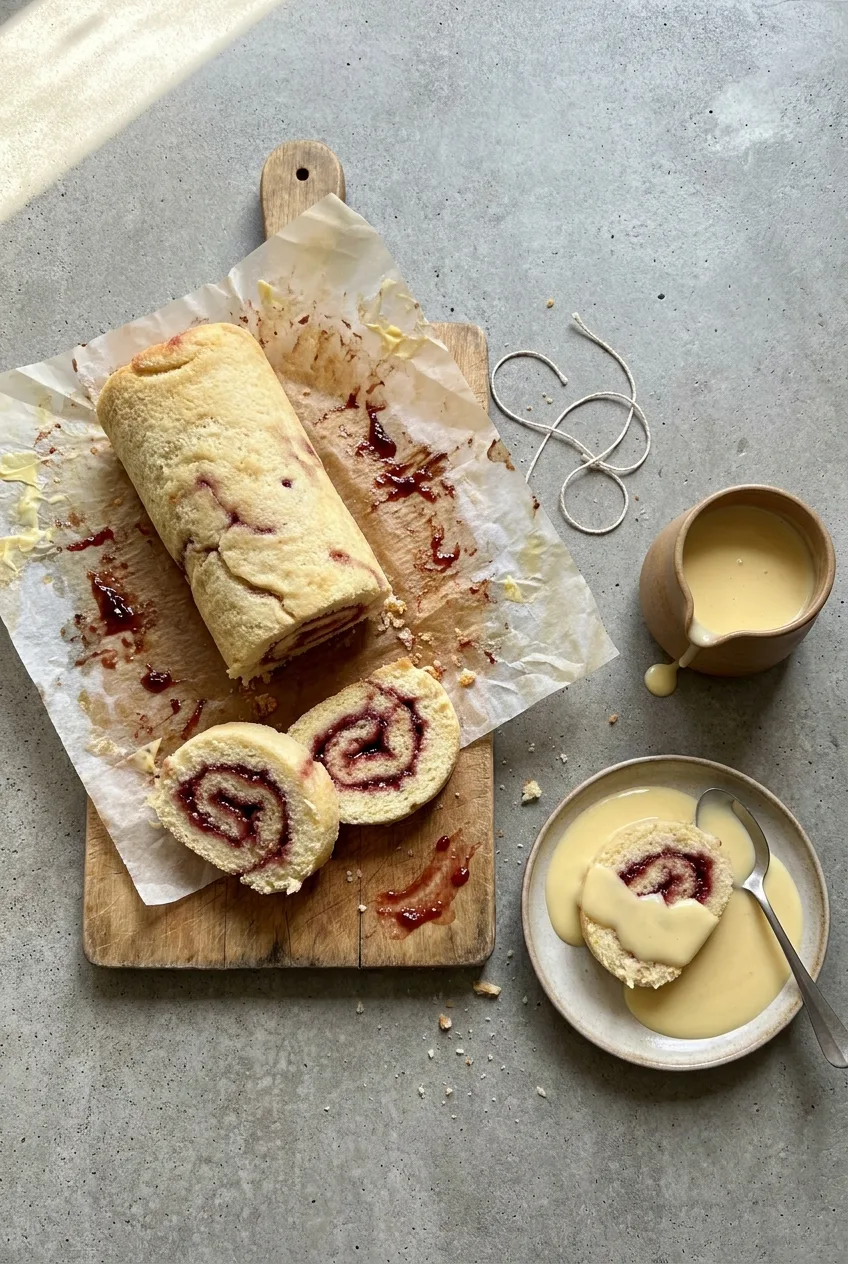
A suet dough rolled around raspberry or strawberry jam, then wrapped, sealed and baked above a shallow bath of just-boiled water. It comes out risen and lightly browned, ready for thick slices and hot custard.
Ingredients
Instructions
- Get ready: Preheat the oven to 200°C/Fan 180°C/Gas 6, then butter a 38 x 38cm sheet of baking paper and set it aside. Place a low rack in a smallish roasting tin.
- Make the dough: Mix the flour, suet, sugar and salt in a large bowl, then slowly add the milk or water, stirring until a soft, spongy dough forms. Knead it well on a floured surface, then roll it out to a rectangle about 22 x 32cm.
- Add the jam and roll: Drop large spoonfuls of jam over the dough, leaving a 1.5cm border all round. Roll it up gently from one of the short ends, then move it onto the buttered paper, seam-side down.
- Wrap it twice: Wrap the roly poly in the paper with a long pleat so it can rise, then twist the ends and tie them with string. Repeat with a large sheet of foil, pleated and twisted the same way.
- Bake over water: Set the pudding on the rack in the tin and pour just-boiled water around it, no more than a centimetre up its sides. Bake for about an hour.
- Unwrap and serve: Lift the pudding off the rack, unwrap the foil, snip the string and open the paper. It should be well risen and lightly browned, so cut thick slices and serve with hot custard or cream, and never mind any jam that escaped.
FAQs
What is suet, and can vegetarians eat this?
Suet is a hard fat sold shredded in boxes, and it melts slowly as the pudding cooks, which is what makes the sponge so light and open. Butter melts too fast to do the same job, so this is one bake where suet earns its place.
Vegetarians are covered, because the Mums Know Best version of this recipe says plainly to use vegetable suet. It shreds and bakes the same way, so nothing else in the method changes.
Why is it called jam splat in Si’s house?
Because that is the family name for it, according to their Mums Know Best book, which also remembers the “much-mutilated” school dinner version most of us grew up on. Their point is that home-made bears no resemblance, so it deserves a proper go.
Interestingly, that earlier book bakes the same pudding for just 35 minutes, while British Classics gives it the full hour. The longer bake browns it more deeply, which is the version this page follows. For another school pudding done properly, their sticky toffee pudding settles the argument too.
Why does it bake over a tin of water?
Because this pudding is half baked and half steamed, and the water is what keeps the inside soft. The oven browns the wrapped outside, while the steam rising around it stops the suet sponge drying out.
Keep the water shallow, since the book warns it must not rise more than a centimetre up the pudding’s sides. Any deeper and the bottom boils rather than bakes.
Why roll from the short end?
Rolling from the short end gives fewer, fatter turns, so every slice shows a thick spiral of jam rather than thin streaks. It also keeps the pudding compact enough to fit its paper wrapping.
The 1.5cm bare border matters just as much, because jam spread to the edges leaks straight out when rolled. Some escape is fine anyway, and the book says leaked jam only tastes better.
Do I need custard with it?
The book plainly thinks so, since it points you to their own proper custard recipe and calls custard the finish. Cream works too, but a hot pudding under hot custard is the whole tradition here.
If baked custard is more your thing than poured, their bread and butter pudding takes the same comfort in a different form. Either way, the jug matters as much as the pudding here.