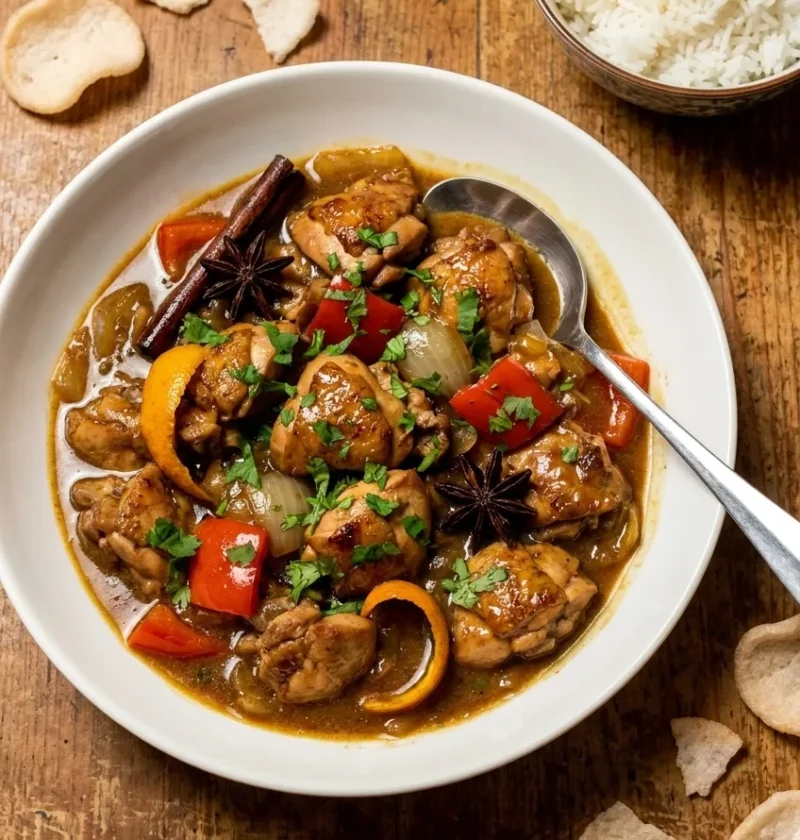
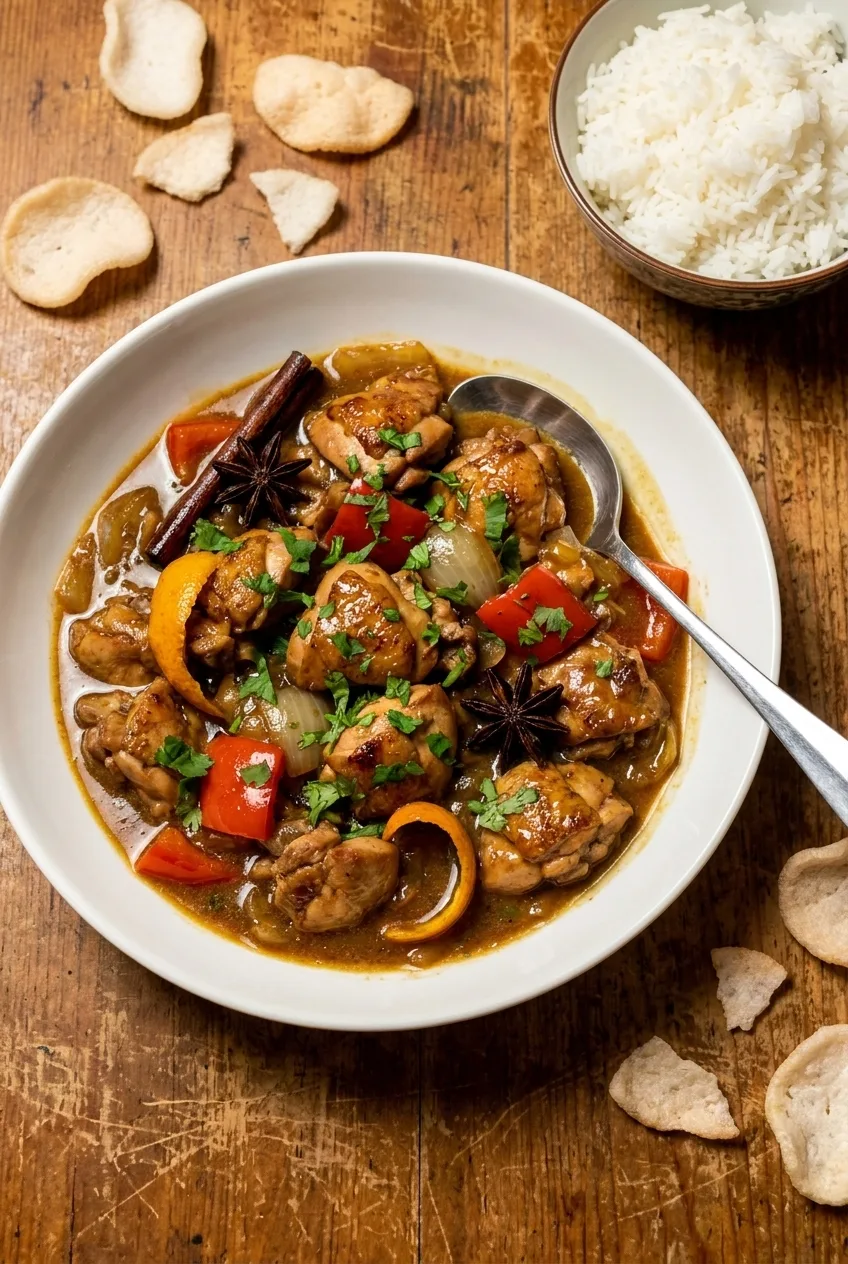
Star anise, a strip of orange peel, and half a cinnamon stick are what give this Hairy Bikers Chinese chicken curry that takeaway smell the moment the lid comes off. The sauce comes from the Asian Adventure cookbook, and 800g of boneless thighs simmer in it for 25 minutes at around 505 kcal.
The cookbook has this as a Chinese Beef Curry, and the headnote says “Chinese curries have a unique character which we’re familiar with from takeaways.” Every spice and every quantity in the sauce is from that recipe, with chicken thighs swapped in for beef shin and the simmer cut from two hours to twenty-five minutes.
Most curry recipes stir cornflour into water at the end to thicken the sauce, but this one fries the cornflour with the spices before any liquid goes in. That starchy coating on the onions and peppers dissolves into the stock as it simmers, so the sauce thickens on its own without that gloopy texture you get from a last-minute slurry.
Hairy Bikers Chinese Chicken Curry Recipe
Description
Boneless chicken thighs browned and simmered in a sauce built from star anise, cinnamon, orange peel, curry powder, Shaoxing rice wine, and soy sauce. Adapted from the Chinese Beef Curry in the Asian Adventure cookbook.
Ingredients
For the curry
To serve
Instructions
- Brown the chicken: Heat half the oil in a large heavy-based pan over a high heat. Season the chicken with salt and pepper, then brown in batches until golden all over. Remove each batch to a plate while you cook the rest.
- Fry the aromatics and spices: Reduce the heat to medium and add the remaining oil. Sweat the onions and red peppers for a few minutes until just softening, then add the ginger and garlic and cook for another minute. Drop in the star anise, cinnamon stick, and orange peel, then add the curry powder and chilli powder. Sprinkle in the cornflour and fry everything together for a further minute, stirring so the spices do not burn.
- Deglaze and build the sauce: Tip the chicken back in with any resting juices and stir to combine. Turn the heat to maximum, pour in the Shaoxing wine, and let it bubble until reduced by about half. Pour in the stock, bring to the boil, and skim anything that rises.
- Simmer: Turn the heat down and place the lid slightly askew so the pan is not fully covered. Leave to simmer for about 25 minutes until the chicken is tender and the sauce has reduced enough to coat the back of a spoon.
- Finish: Stir in the soy sauce and scatter over the coriander if using. Serve with bowls of rice.
FAQs
Why does the soy sauce go in at the very end?
Because soy sauce loses its punch if you cook it for too long. The original cookbook method adds it in the final step after the simmering is done, and the reason is that a long simmer breaks down the fermented flavour and leaves the sauce tasting flat and salty rather than savoury.
Adding it right at the end means you taste the full depth of the soy alongside the star anise and orange peel, not just the salt. This is a detail the cookbook is specific about, and most recipes online miss it completely.
Why is the stock reduced from the beef version?
The beef curry uses 700ml of stock and simmers for up to two and a half hours, so most of that liquid evaporates and the sauce concentrates naturally. Chicken thighs only need 25 minutes, which is not enough time to reduce 700ml down to a thick sauce.
500ml gives the sauce enough liquid to cook the chicken through while still reducing to the right consistency. The cornflour fried into the spices at step 2 does the rest of the thickening work, so you end up with a glossy sauce rather than a thin broth.
What does the orange peel actually do?
It gives the sauce a citrus warmth that sits behind the star anise and cinnamon without tasting obviously orangey. The cookbook calls for a strip about 8 by 2cm, and you leave it in during the whole simmer so the oils release slowly into the broth.
This is what separates a proper Chinese curry from just chucking curry powder into stock. The chicken chasseur on this site uses the same technique with bay leaves and thyme instead of orange peel, and the effect is the same: a single herb or peel left to infuse changes the whole sauce.
Can I add coconut milk to this Chinese chicken curry?
You can stir in 100ml of coconut milk in the last 5 minutes if you want a creamier finish, though the cookbook version does not use any. The Shaoxing wine and soy sauce already give the sauce plenty of body on their own.
Adding coconut milk will push the flavour closer to a Thai or Malaysian curry, so it depends whether you want a Chinese takeaway taste or something richer. The chicken korma on this site uses ground almonds for creaminess instead of coconut milk, which is another way to thicken a curry sauce without changing the flavour as much.
Can I make this Chinese chicken curry in a slow cooker?
You can, but there is no real advantage since boneless thighs only need 25 minutes on the hob. The whole point of this adaptation is speed, and a slow cooker turns a quick midweek curry into an all-day project for no benefit.
If you do want a proper slow-cooked curry, use the original beef shin version from the cookbook instead. The beef genuinely needs 2 hours to break down, and it works well on low for 6 to 8 hours. The chilli con carne on this site uses the same brown-then-braise method with diced braising steak, so it makes a good slow cooker alternative for another night.