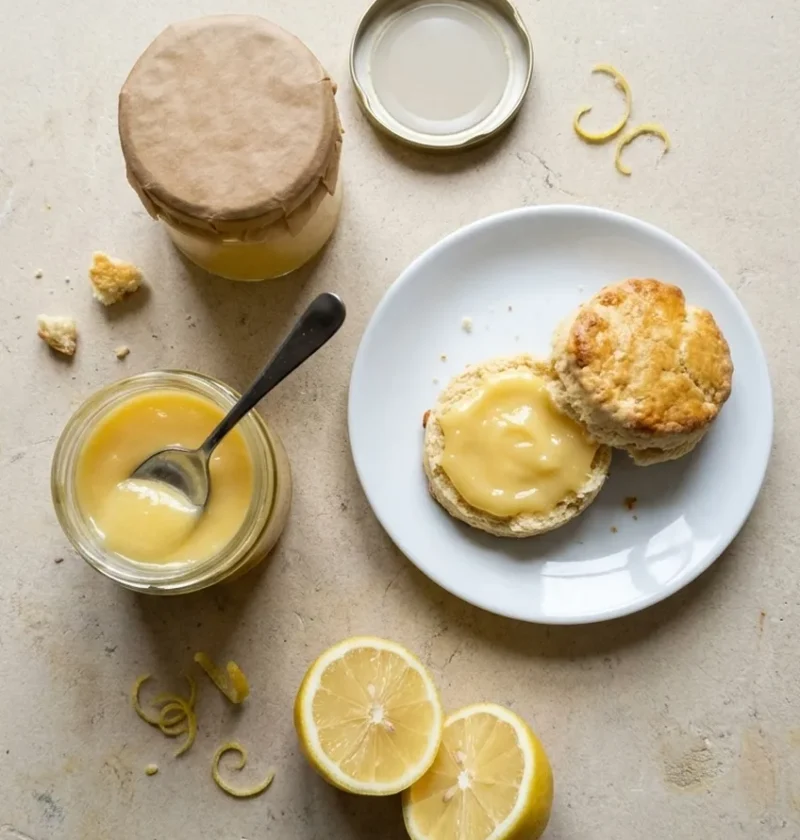
This Hairy Bikers lemon curd recipe cooks the juice of 6 lemons and zest of 3 with eggs, yolks, sugar and butter over simmering water. With my hour of cooling, the Brilliant Bakes batch fills 4 jars in about 1½ hours, at an estimated 620 calories a jar.
They remember it as “a good old-fashioned treat and something our mams used to make” in Brilliant Bakes, and it’s in three of their books. But where some curds use yolks alone, theirs takes 4 whole eggs plus 4 extra yolks, along with a generous 6 lemons.
Gentle heat is everything here, because the bowl sits over “very gently simmering water” while you whisk constantly for 10 to 12 minutes. And they make sure the bowl never touches the water, because I’d expect that extra heat to scramble the eggs before the curd thickens.
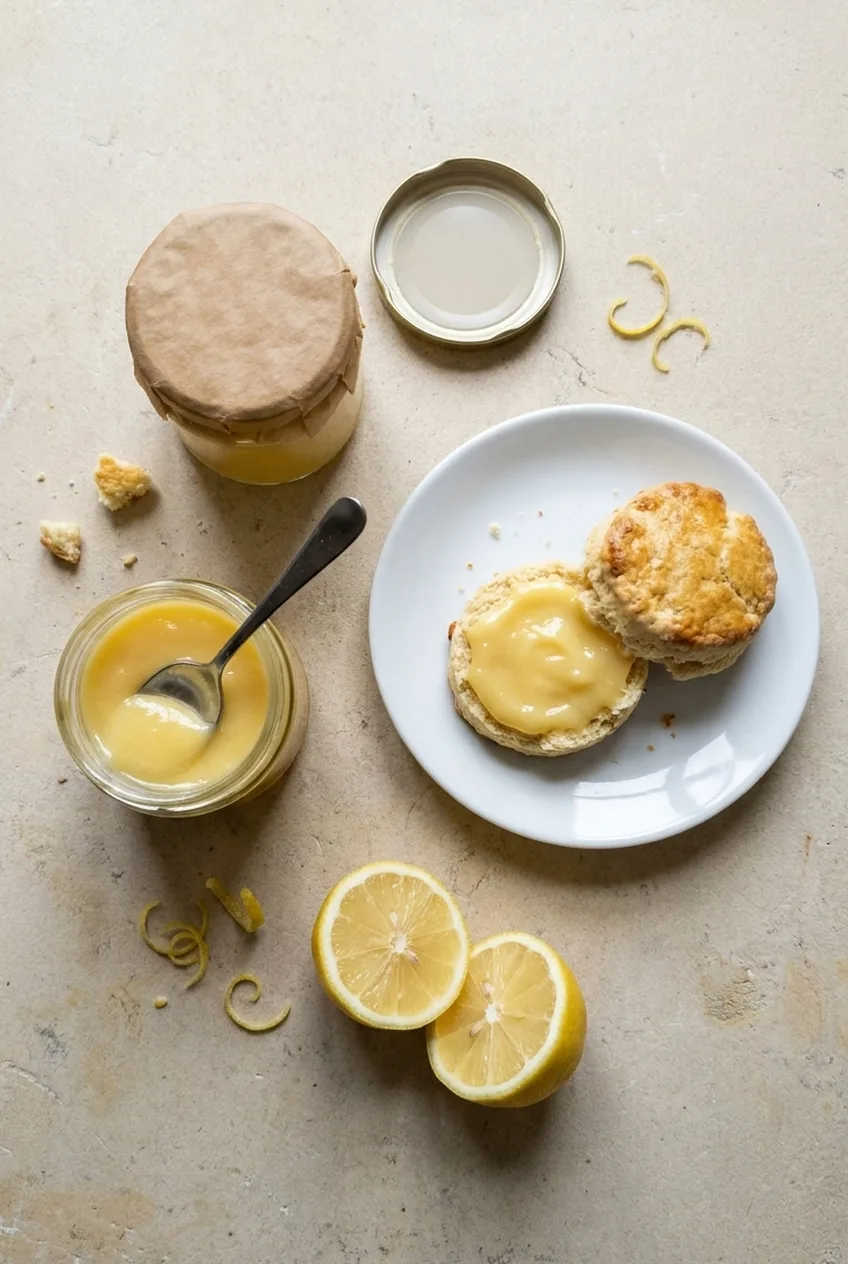
Hairy Bikers Lemon Curd
Description
Whole eggs and yolks are whisked together, then sugar, lemon juice, zest and cubed butter go in over a pan of barely bubbling water. Once the butter melts, constant whisking thickens it to a custard-like curd, which goes hot into sterilised jars.
Ingredients
For the lemon curd
Instructions
- Sterilise the jars: Run the jars through a hot dishwasher cycle, or wash them in hot, soapy water, rinse well and dry them in a low oven. Then make sure they’re completely dry before filling.
- Mix: Whisk the eggs and egg yolks in a large heatproof bowl until well combined. Then add the sugar and stir in the lemon juice and zest.
- Set over the pan: Add the butter, then place the bowl over a saucepan of very gently simmering water, making sure the bowl doesn’t touch the water.
- Melt and cook: Stir with a wooden spoon for 5 minutes until the butter has melted. Then cook for 10 to 12 minutes, whisking constantly. And it’s ready when it has the consistency of custard and leaves a light trail when the whisk is lifted.
- Jar it: Pour the hot curd into the sterilised jars and leave it to cool, while it keeps thickening in the jars. Then cover it with a disc of waxed paper or baking parchment and seal with a lid.
- Store: Keep it in the fridge and use it within a couple of weeks.
FAQs
Why do you get 4 jars in one book and 5 in another?
The same quantities appear in Brilliant Bakes and Chicken & Egg, yet one makes 4 jars and the other 5. Neither gives a jar size, so I’d put the difference down to the jars they used, which is my reading rather than theirs.
In Our Family Favourites, a close version with 250g of sugar and 200ml of measured lemon juice makes 750g instead. So I’d count on roughly that much here and keep a spare small jar ready, which is my own estimate.
Do you need unwaxed lemons and free-range eggs?
In Brilliant Bakes they ask for unwaxed lemons, while in Chicken & Egg they call free-range eggs and unwaxed lemons “well worth using”. Since the zest of 3 lemons goes into the curd, I’d stick with unwaxed, so there’s no wax coating on the zest.
They also mention that limes and oranges make lovely curds, though no separate quantities are given for those.
How do you sterilise the jars?
In Brilliant Bakes, a hot dishwasher cycle does the job, or you wash, rinse and dry the jars in a low oven. But in Chicken & Egg, the jars get half an hour at 140°C/Fan 120°C/Gas 1 to dry completely.
Then the hot curd goes into warmed jars in the Chicken & Egg version, which I’d follow so cold glass never meets hot curd.
How do you know it is ready, and what about the spare whites?
It’s ready when it’s like custard and leaves a light trail as you lift the whisk. And don’t wait for it to set thick in the bowl, because they point out it carries on thickening in the jars.
With 4 yolks in the curd, you’re left with 4 whites, which matches the 4 large whites in their Mums Still Know Best pavlova. So I’d make the curd first, then whisk the whites into a meringue the same day.
What can you use it for?
They suggest slathering it on a scone, a teacake, bread or a toasted crumpet, or using it to fill a cake. In Chicken & Egg, their lemon curd cake calls for it, with 200g of curd and 200ml of whipped cream between two lemon sponges. And in Brilliant Bakes, their St Clement’s Battenberg uses lemon curd or apricot jam to stick the sponges together.
For baking, their lemon and blueberry muffins from British Classics get a teaspoon on top of each one before they go in the oven. Or split a batch of their British Classics fruit scones and spread it on warm.