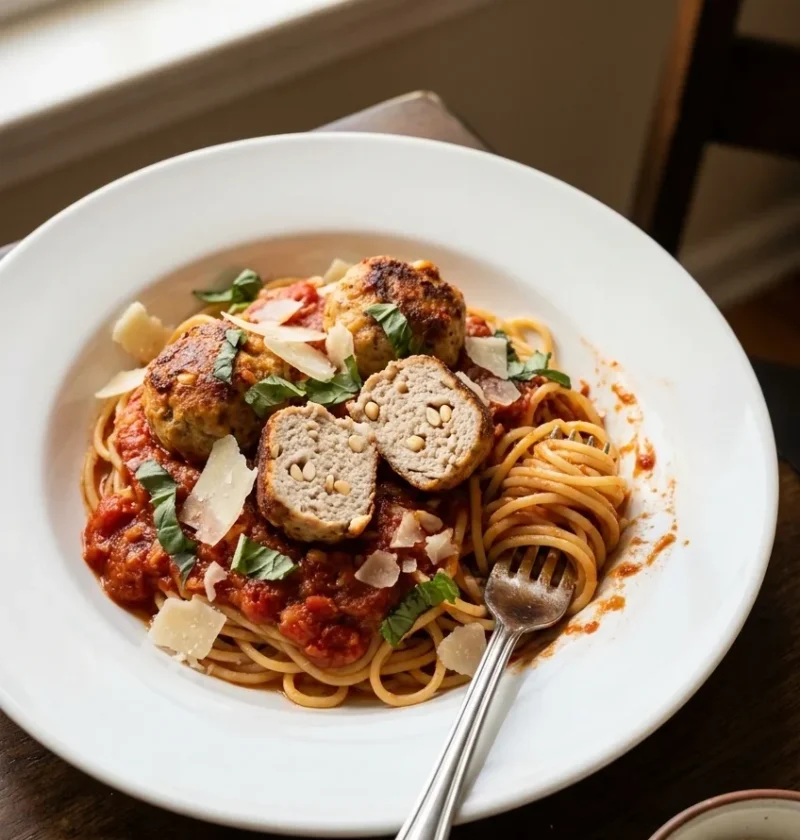
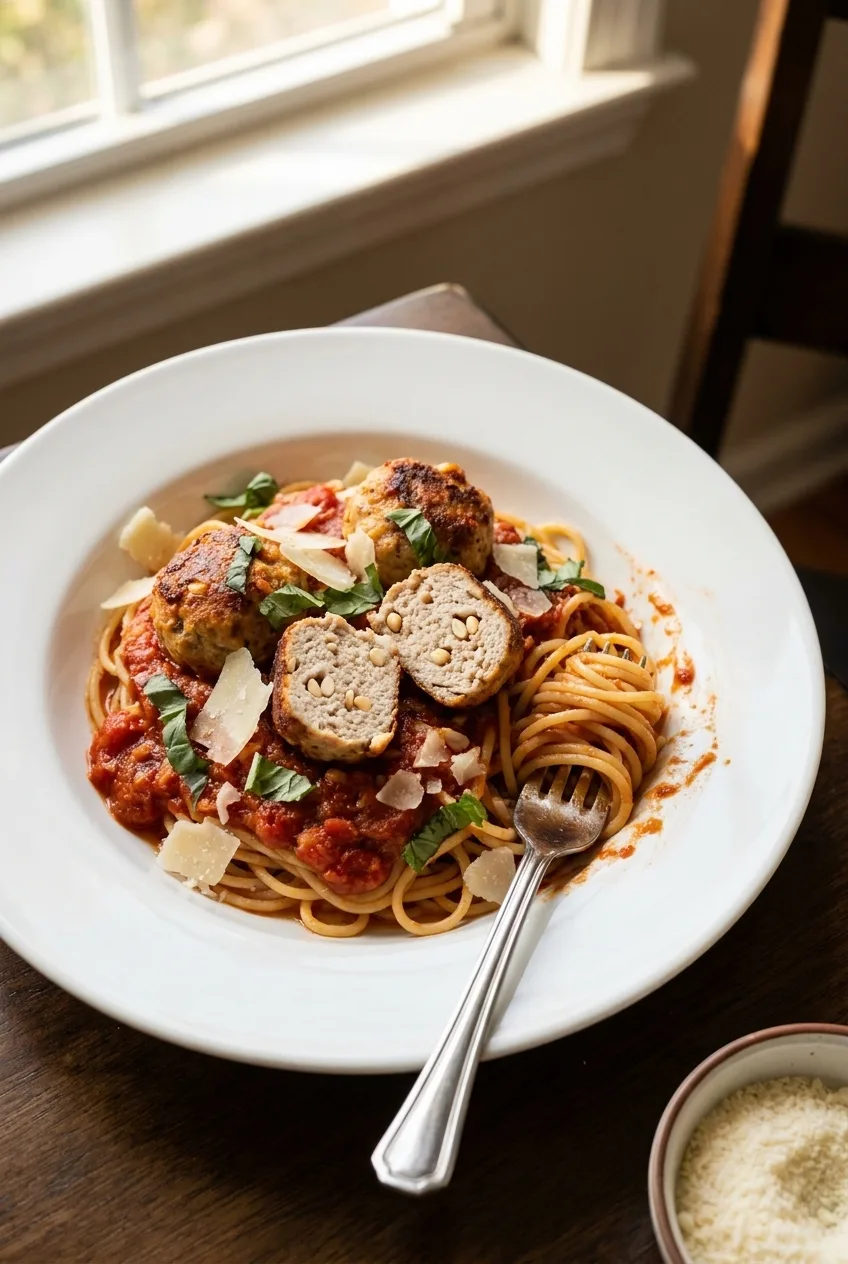
Hairy Bikers spaghetti and meatballs from Everyday Winners uses pork mince with pine nuts and lemon zest, which gives each ball a crunch and freshness most recipes miss. The meatballs bake while the tomato sauce simmers, so everything comes together in about an hour and serves 4 at around 680 calories.
Most spaghetti and meatball recipes mix beef and pork, but this goes all pork for a softer ball that holds the pine nuts without turning dense. Fresh basil goes into the meatballs and the sauce, so the herb flavour connects both halves of the dish rather than sitting only in the tomatoes.
Baking 20 meatballs on a lined tray at 200°C means no standing at the hob turning them in batches. The oven sets the outside before they hit the sauce, so they hold their shape during the simmer instead of falling apart.
Hairy Bikers Spaghetti and Meatballs Recipe
Description
Twenty pork meatballs packed with chopped pine nuts, lemon zest, oregano, and fresh basil, baked until golden then dropped into a tomato sauce built on white wine reduced by half. Served over spaghetti with grated Parmesan.
Ingredients
For the Tomato Sauce:
For the Meatballs:
To Serve:
Instructions
- Start the sauce: If using fresh tomatoes, score a cross on the base and plunge into boiling water for 10 seconds, then peel and roughly chop. Heat the oil, cook the onion until soft, add garlic and oregano, then pour in the white wine and let it reduce by half. Add the tomatoes, season well, cover, and simmer for 30 minutes.
- Make the meatballs: Preheat the oven to 200°C/Fan 180°C/Gas 6 and line a tray with baking parchment. Fry the onion until soft, add garlic, oregano, lemon zest, and chilli flakes, then take off the heat. Mix into the pork mince with the pine nuts, basil, breadcrumbs, and egg. Season and shape into 20 balls.
- Bake and combine: Bake for 15 minutes until browned and cooked through. Taste the sauce and add a pinch of sugar if it is too acidic, then stir in the basil. Drop the meatballs into the sauce and simmer for a few minutes.
- Serve: Cook the spaghetti according to the packet. Spoon the meatballs and sauce over the pasta, tear over basil leaves, and serve with plenty of grated Parmesan.
FAQs
Why put pine nuts in the meatballs?
Chopped pine nuts give crunch inside soft pork that breadcrumbs alone cannot match, and they release oil during baking which keeps each ball moist. Most meatball recipes rely on egg and breadcrumbs for texture, so the pine nuts are what make these taste different.
They toast slightly during the 15 minutes at 200°C, which brings out a nutty sweetness that pairs with the lemon zest. If you cannot find pine nuts, roughly chopped walnuts work but give a stronger flavour. The Swedish meatballs from British Classics skip nuts entirely and use anchovies as their secret ingredient instead.
Why does the recipe use all pork and no beef?
Pork mince produces a softer, lighter meatball than beef because it has a higher fat content and a finer grain. This version goes all pork so the texture stays tender after baking, and the higher fat keeps the balls moist without needing extra liquid.
Lemon zest and chilli flakes suit pork better than beef, because pork carries bright flavours while beef pushes everything heavier and darker. If you want a beef version, the One Pot Wonders tray bake uses all beef with cream and Parmesan mixed directly into the meatball mixture. For a lighter pork version at 282 calories, the Italian meatballs in tomato sauce use lean mince with grated carrot for moisture.
Can I make this as a tray bake instead?
Yes, and the One Pot Wonders cookbook has a version where meatballs, pasta, tomatoes, and milk all go into one roasting tin at 220°C. That recipe uses 8 large beef meatballs with cream and Parmesan mixed in, plus milk in the sauce which sweetens it.
The milk thickens the sauce so the pasta cooks evenly inside the tin without drying out. It comes out with melted mozzarella on top after 55 minutes, and the whole thing needs just one dish to wash up.
Why reduce the wine by half before adding tomatoes?
Reducing 100ml of white wine by half concentrates the flavour and cooks off the raw alcohol before the tomatoes go in. If you add wine and tomatoes at the same time, the alcohol takes much longer to burn off and the sauce tastes sharp rather than rich.
This is the same deglazing technique used in French cooking, where wine hits a hot pan and reduces to a syrup before liquid is added. The concentrated wine gives the sauce a depth that tinned tomatoes alone cannot reach.
Do I need to peel fresh tomatoes?
The recipe says to score a cross on the base, drop each tomato into boiling water for 10 seconds, then peel. The skins tighten and curl back, so they slide off in one piece once the tomato is cool enough to handle.
It also says not to strain the seeds, because the liquid and jelly around them carry flavour that most people throw away. Tinned tomatoes work fine and skip the peeling, but the difference is noticeable in a sauce this simple where the tomatoes have nowhere to hide.